Belonging Project Podcast
Return-to-office policies are exposing a hidden leadership gap
Belonging at work is not just about feeling welcomed. It’s about whether people feel they can succeed without having to erase the realities of their lives.
Why flexibility conversations are really about belonging and modern leadership
Return-to-office conversations are often framed around productivity, collaboration and company culture.
But what if they are also revealing something about belonging, leadership and whose lives workplaces were originally designed around?
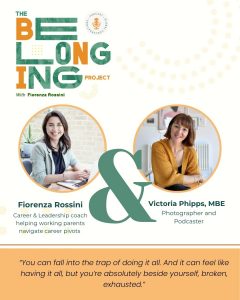
In this solo episode, I reflect on the emotional and practical realities many working parents are navigating behind the surface of business as usual.
For many professionals, especially parents of young children, the return-to-office conversation is really not about commuting or flexibility. It is about:
- How much someone can realistically hold and carry
- Identity
- Visibility
- Ability to sustain
- The pressure to continue performing as though life has not fundamentally changed.
In this episode, I explore:
- Why return-to-office debates feel emotionally charged for many parents
- The invisible mental load behind showing up
- How workplaces still holding old beliefs
- The leadership skills caregiving often develops
- Why reduced capacity is not the same as reduced ambition
- The connection between belonging and psychological safety at work
- What sustainable success might look like across different chapters of life
This episode is for anyone who has ever wondered:
Can I still grow professionally without working exactly as I used to?
And perhaps more importantly:
What kind of workplaces will people remain loyal to in the future?
🔗 Links & resources
⭐⭐⭐⭐⭐ If you’ve enjoyed this episode, please leave a rating and review!
Host
Fiorenza Rossini
Career and Leadership coach helping working parents navigate career pivotsFiorenza started building her coaching business in 2016 while still working in investment banking. When her first child was born in 2019, she knew something had to give. Like many parents, she realised she couldn’t keep growing her career in the same way while also being the parent she wanted to be. Her priorities became clearer, and she chose to leave corporate life to focus fully on her coaching work. Today, Fiorenza supports driven professionals & leaders who are also parents of young children, who find themselves to be at a pivot point - whether that’s returning to work, stepping into leadership, or rethinking what career growth now looks like.
Read Transcription
Fiorenza Rossini (00:52)
I’ve been thinking a lot lately about the return to office conversation. And what I mean by that is not just as a workplace policy discussion, but really as a belonging conversation. Because for many working parents, especially parents of young children, return to office policies are not simply about commuting.
They are exposing whose lives workplaces were originally designed around.
And I think that’s why this conversation feels so emotionally charged for so many people. Because people don’t necessarily never want to be in an office again, no. But I think because I think once life changes you, it becomes very hard to pretend that nothing had changed at all. And that’s what happens with parenthood, especially in the early years. It really changes you. And I don’t…
just mean emotionally but I also mean practically, I mean mentally, mean rationally, relationally. Your time has changed and how you view time has changed, how you view your energies has changed, how you view your priorities has changed. Don’t get me wrong, I’m not saying that work isn’t a priority anymore but
it has changed, the priorities have changed and they probably became more complex. Yet what we see is that many workplaces systems are still assuming that nothing has changed with parenthood, that perhaps we take some time off and we come back and we pick things up exactly where we left them off and more specifically that we pick things up exactly how we left them. So…
I think workplaces just assume that we can stay late unexpectedly, that we can travel easily, that we can join evening events, evening socials, just, you know, very last, with very short notice. And that’s not the reality of a working parent because…
If you are both working parents, which is by the way the majority of people in our generation and in the UK, it means you have to arrange childcare. Perhaps you’re in the lucky few and you have some family support close to you. But if you don’t, it means that you have to find a nanny, you have to find a babysitter. And that’s not something that you can do last minute most of the time. Right? So…
For a lot of parents and especially parents of young children, there is always this invisible negotiation that is happening underneath all of this, right? Like the requests from work, especially those extras, those add-ons, and then what is actually required of you as a parent and how you want to fulfill that on the other side. And we might find ourselves in this push and pull situation a lot of the time.
Can I make this event? Is the nurse gonna call me today? My child was, if it’s not yesterday, as he’s turned into a full blown up cold. Who’s doing pick up today? What happens if my child is ill again? Can I realistically take this promotion right now? Can I realistically make this business trip right now?
How much energy do you actually have tonight? Can I go back to working on my spreadsheet? Yeah. Those are only a few of the questions that working parents ask themselves in the early years.
shows that flexibility has become one of the biggest drivers of retention for working parents. Reports from Deloitte and McKinsey continue to show that many parents have considered leaving roles because of the challenge of balancing work demands with caregiving responsibilities.
And interestingly, it’s not about wanting to work less. It’s about wanting work to fit into real life in a more sustainable way.
And yet we find many people feeling the pressure to perform. To perform normally. As if nothing has changed.
Most of the time, we still deeply care about our career, but you can no longer sustain the way that you used to work. That’s the main point in my view. And often, unfortunately, it gets misinterpreted as reduced
ambition.
I think the return to office conversations are exposing something deeper about leadership cultures. They’re exposing how many organizations are rewarding visibility and how they are using that as their main KPI for success and career evolution and career promotion. Speed over reflection or physical presence over effectiveness and actual productivity, availability over boundaries.
And yet, the evidence about productivity is far more nuanced than many headlines suggest. Multiple studies on hybrid work have shown that productivity does not automatically decline outside of the office. In some cases, it improves because people have greater autonomy, fewer interruptions, and some control over the time and energy.
Many of the skills that caregiving develops are deeply valuable leadership skills and often they are completely overlooked. Which are those skills? Prioritisation, adaptability, emotional regulation, decision-making under pressure, empathy, perspective, efficiency. Right?
Parents often become exceptionally good at identifying what actually matters because they no longer have endless bandwidth.
But those skills are not recognised There is often an unspoken ideal worker image floating around. Have you noticed? Someone endlessly available, flexible in only one direction, able to organize their life around work at all times. The perfect employee, isn’t it? I’m joking. Or am I not? We exclude so many.
ways in which we are human. People caring for aging parents, yeah, you might have heard of the sandwich generation. People navigating health challenges, people with complex lives, identities, responsibilities, or different definition of success that do not always fit the mold. I think one of the most interesting questions organizations could ask themselves right now is, what if sustainable leadership does not look like constant optimization?
What if high performance across a lifetime requires different rhythms at different chapters of life? Yeah, careers are long. And people change across life, and so do people change across careers. What someone can give at 28 may look different at 38 or 48, and that’s okay. It doesn’t mean that there is less value, it just means different value. I think belonging at work is deeply connected to this.
Belonging is not just whether someone feels welcomed, it’s whether they feel they can succeed without having to erase the realities of how they are living. They don’t have to hide caregiving responsibilities, exhaustion, without feeling penalized for needing flexibility, without feeling less than.
There is also growing evidence that employees increasingly value flexibility as part of psychological safety and trust, not simply convenience, which tells us that this conversation is no longer really about location alone, it’s about culture.
I always think many parents are grieving parts of their previous professional identity. yeah, transitions are complicated. You can deeply love your children and still feel disoriented by how much your relationship to work, ambition, time, and yourself has changed. We don’t talk enough about that nuance. And perhaps that’s why so many people feel isolated in this stage of life:
because externally they may still look high functioning, but internally they are rebuilding. Rebuilding identity, rebuilding confidence, rebuilding priorities, rebuilding what success now means. Honestly, I don’t think workplace is fully caught up with this reality yet. I don’t think the future of work will be built by asking people to work exactly as they did before life changed them.
I think the organisations that people remain loyal to will increasingly
Be the one that understand that capacity is not fixed. Leadership evolves across life and that supporting people through those seasons of life is not lowering standards. It’s recognising humanity and meeting your people where they’re at.
So I think from a coaching perspective, one of the things I see most often in my work is definitely not a lack of ambition. What I see is people questioning themselves because their capacity, their priorities of ways of working no longer look the same as they once did. Many working parents are carrying an invisible comparison between who they used to be and who they are now.
The version of themselves who could say yes more easily, could move faster, who could push harder, who could stay available longer. But perhaps growth in this season is not about becoming that version of yourself again. Perhaps it’s about learning to lead, learning to contribute and succeed in ways that are more intentional and more honest about the realities of your life.
And I think there’s something important in recognising that needing different support, different boundaries or different rhythm doesn’t always automatically mean that you’re less worthy or that you’re less capable. Simply means that your life has become different. And maybe the question is no longer, how do I keep performing exactly as before, but it
shifts to what does meaningful sustainable success look like for me now? That’s a different question and perhaps a much more human one.
Thank you so much for listening to this episode. And if this conversation resonated with you, I’d genuinely love to hear your reflections. You can connect with me on LinkedIn or share this episode with someone who made it this right now. See you next time.