Belonging Project Podcast
Resilience and Navigating Life’s Shakes-Ups with Lucy Werner
I have to be gentle with myself that it’s not accelerating in the way that I want it to… you can’t always see the fruits of the labor now.
Who are you when you lose your voice?
Host
Fiorenza Rossini
Career and Leadership coach helping working parents navigate career pivotsFiorenza started building her coaching business in 2016 while still working in investment banking. When her first child was born in 2019, she knew something had to give. Like many parents, she realised she couldn’t keep growing her career in the same way while also being the parent she wanted to be. Her priorities became clearer, and she chose to leave corporate life to focus fully on her coaching work. Today, Fiorenza supports driven professionals & leaders who are also parents of young children, who find themselves to be at a pivot point - whether that’s returning to work, stepping into leadership, or rethinking what career growth now looks like.
Guest
Lucy Werner
Founder & Author of Hype YourselfLucy is the cofounder of three children and author of three books. And she wants to help self-employed folks get seen and get paid through her paid newsletter community, masterclasses and retreats.
Read Transcription
Fiorenza (00:52)
I’m so
be sitting down with Lucy Werner. Hi Lucy.
Lucy (00:57)
Hi, thank you for having me.
Fiorenza (00:59)
For those who don’t know Lucy, she’s the co-founder of Three Children and author of three books, which I actually casually just have one on my desk.
Lucy (01:11)
The best one, the first one.
Fiorenza (01:12)
I love it. I love it. It’s definitely one of my business books staples. Lucy helps self-employed folks get seen and get paid through a paid newsletter community, master classes and retreats.
Lucy (01:26)
you’re actually one of my paid readers!
Fiorenza (01:30)
Yeah,
and also I have your book, so big fan here.
Lucy (01:32)
Yes, definitely.
Fiorenza (01:36)
So you’ve had ⁓ more than 20 years experience. Well.
more than 20 year career in PR before you started and you built your own business and your own community. Looking back, when do you think you had that feeling or perhaps that moment where you felt that actually you were meant to do something different or you wanted to do something different?
Lucy (01:59)
that’s a really good question. And there’s definitely some kind of sort of moments that happened. For me, it wasn’t, I know that a lot of people, it can happen in motherhood because they have that like return to work. Mine was before that. I was working in a PR agency. I’d worked in many PR agencies and startups. And I think at the end I was doing all the good stuff, know, like e-cigarettes, gambling.
like lopes and alcoholic wine, all these sort of things. I thought, I don’t really care about you guys making more money. It wasn’t really fulfilling myself. And at the same time, I was at the age where a lot of my peers were starting to build their own businesses or create their own things. And so I kind of made this leap to, well, really I thought I was just going to go freelance and work on projects, but before I knew it, it kind of turned into a micro agency.
Within a year I had staff and apprentices and people on payroll. So that kind of was sort of fulfilling this need of I want to help people who maybe don’t have the big agency budget that want to take on an agency to promote themselves.
Fiorenza (03:05)
Yes and your business morphed even after that and you have your books. When did the books happen perhaps?
Lucy (03:14)
Yeah,
so when I left PR agency land, like a lot of people, when we work in the corporate space, we kind of start off because we like the craft of it. And as we become more more senior, we’re not working on the craft of it anymore. We’re kind of creating spreadsheets or managing teams without any training on how to manage teams or how to manage spreadsheets. It’s almost like a completely different job. So I was back to the shop floor, really.
And I thought I need to brush up my skills on how to pitch to press because it’s been a while since I’ve done it. Like I always thought I was good at it, but I thought I need to refresh. So I started buying PR books and they were all either written by male journalists, not that I have an issue with male journalists, but the majority of the PR land is like two thirds female led. So I really struggled to find PR books written by women. And
Even then, most of the bestselling PR books were written by journalists. And I was like, there’s a whole piece missing here. It’s not just pitching to press, it’s actually knowing what your business goals are and what your messaging is. And that needs to underpin it, because in a way, anybody can kind of learn how to get into a newspaper. But if it’s not helping your business, what’s the point? So that kind of what sparked the idea. I had no idea where to start. So I joined
a book proposal writing challenge with my publisher, what is now my publisher. And at the end of that challenge, I won my book deal. So that was that. in the run-up to that book coming out, I knew I didn’t have an audience. And so I sort of set myself a target. I think I said like, I’m gonna get 10,000 on Instagram, because back in those days, that’s when you could put a link in stories. Obviously anyone can do it now, but back in the day.
You could only put a link in if you had 10,000. So I was aspiring to get these 10,000 followers so I could swipe up for my book. And I just started also then promoting myself. And what I realised was that to grow my audience, it wasn’t press coverage that was growing it, it was going onto podcasts or speaking on stages or hosting workshops. That was what was growing my audience. And so I focused a lot on doing that. And then as the time went on,
Obviously we had lockdown. A lot of people played in the online business world in lockdown because we were obviously locked down. And then I had a few things sort of happen in my life that made me think, I’m going to fight the bullet here and have a go at living in France. My husband’s French. Let’s give it a couple of months.
you know, test it out. kind of MVP’d it like a new business project. And literally the first week I was there, I had two brands approach me about creating content and getting paid as an expert for them. One of whom I still work with today, which is Adobe Express. But it suddenly opened my eyes up to actually, if I’m not focusing all of my time on clients, then I’ve got time and slash I have to.
making income from these other things.
Fiorenza (06:19)
And so if we go back a little bit, while living in London, you decided to step out or step away from the big PR agency. You created your own micro PR agency. and you had the books. Yeah. And before you moved to France, you had two kids, is that right?
Lucy (06:38)
Yeah, so I think two things happen professionally and personally. So professionally, even though I was running like an affordable PR agency, the model pivoted a bit and I, after the first child, I was like, actually, I think I kind of want to streamline this a bit more because even the overheads of having an office and people on payroll were a lot and then obviously you’ve got to pass that on to the client. So I started to move away from the retained agency model, which is kind of how you’re trained to do it in
in agency land, they wanted you to get like a 12 month contract. And I stopped doing that. And I would try and take three to six months projects instead. And I would scale up with freelancers that were relevant to each project. And so that’s how I kind of worked out of my first child was born. Then my husband was made redundant. He kind of joined the business and we set up a PR and branding agency and he was running the branding arm. And I was due to kind of like really push him.
as that sort of head of department. And then my second child was born. during that time, just before he was born, my mom had a stroke and she was the carer for my dad. And then my son was born with four, well, three rare four problems, three rare congenital heart malformations, which completely flipped everything on its head. You know, my life.
I was trying to do all the promotion for my husband’s side of the business as well. So that kind of was a real sort of shake up really. And then we were kind of in and out of hospital for seven months and then we went straight into COVID. So actually, I for a lot of people, COVID was this really traumatic time. I think actually I quite enjoyed staying in and not seeing anybody. Like I was quite ready for it. But that whole experience.
definitely made me want to not be, well, I didn’t have the mental capacity to be on the grind in the same way as I was when I had the agency. I didn’t want the responsibility of a team. And I almost didn’t want the responsibility of managing a client’s ongoing as well, because I didn’t really know what was gonna happen next. Like when I took the baby home from hospital, for example, I thought, okay, we’re in the clear now.
And then we weren’t. And then all of sudden it was like another, you know, few months here and a few months there. And so I thought I need to be reliable in what it is that I do. So I need something that’s even more flexible. And to be honest, I didn’t know then that I could do what I am doing now. I just knew I needed to start taking steps towards these other income opportunities. So part of it was kind of
the demand from clients, wanted something more affordable. And part of it was me trying to find something more flexible.
Fiorenza (09:18)
You mentioned it was a big shake up. Several personal life events made you reconsider how you wanted to work, in what capacity and just how more generally. How did you find
a solution? Did you have the solution already in your mind? Was it somewhere in the background? Or did you have to deconstruct, reconstruct?
Lucy (09:41)
I think I always have.
Plan A, Plan B, Plan C. in anything, whether that is personal or professional, I’ve always kind of got the backup plan. So I think I thought I would carry on using the book as the sales tool. And I wasn’t sure maybe I could find out a better way to do online courses, or maybe I was gonna work more with brands, or I definitely didn’t see the newsletter membership model in my future.
at that time. And when I first came out to France, I was still taking on a few projects when I first moved out here, because you know, I needed to pay the bills. And I was doing a lot of one to one coaching, I kind of fell out of love with the online course model a bit. I think there was a real boom in the pandemic, but I really want people to complete things.
And it’s harder to get them to complete things when it’s always, when it’s an evergreen product, you almost need to bring people with you. And I think one of the big things that I wasn’t expecting about going from a city where I speak the language and I have loads of friends to a country where I don’t speak the language and I’m living rural is that complete change of pace.
and what I expected to come up. I thought I was just gonna look at the lake and cry about what happened with my family, but actually it was a much bigger piece around belonging and who was I and where did I fit and who was I outside of my work. And I’d always seen myself as like Lucy Werner PR and then Lucy Werner as two separate people. And Lucy Werner PR was, I almost joked, was like my drag version on Instagram, which was very confident.
She was fun, she was very happy. And it’s not that I’m not those things. It was just, I think the process of going through what I went through personally, I almost used Instagram and my work to pull me through it. And I hid in that persona online. So you would never know unless you were watching my stories or you knew me personally, that there was this going on behind the scenes. It was never on my grid. You know, it was very…
kind of like for me, Instagram, social media was my office. So I wasn’t bringing that to the office. And when I came here, I got pregnant with my third child. And so I have more time than ever at home. And the boundaries of who those two people were suddenly merged way more than they ever had before. In part, I think because I wasn’t sort of pretending to be.
you know, this is work and this is personal because I wasn’t working that much. So I was like, well, I’ve got to post something. So there was a lot of like, here’s my French class, because that’s what I was doing. Or here’s me taking my French exam. This is me applying for my visa. And then I kind of started to grow a new audience of midlife relocationers or just relocationers, to be honest, people who’ve moved countries who resonated with me talking about
what is sometimes amazing, and sometimes devastating moments when you’re in a country that’s not your own. And, and there’s that guilt as well, that it’s the privilege that we’ve chosen to meet those countries, it’s not like we’ve been forced to leave. So you don’t feel like you can complain about it, you feel like you should be happy and content, you’ve been accepted in a new country when so many people don’t get that. So it’s a real
you know, double edged sword all over the place and potentially like a kind of, you know, a bit of a walking nightmare of like, not trying to not say something that’s going to be seen as offensive and get you cancelled because you’ve inadvertently made a critique on somebody’s culture without meaning to or something, you know. So it was a real, a real process. And I’m sure you know that from the other side, like the other way.
Fiorenza (13:25)
Yeah, and when I started following you on Instagram, the thing that resonated the most was what I was seeing about you doing the reverse journey, because I moved to London from France and you moved away from London to France. So that was exciting in its own way to see someone on the reverse journey. And I don’t think I…
I know I had known at that point someone who did the reverse journey but also documenting it because there’s actually, I think it’s quite, it’s relatable. I like the injections of personal stuff
on Instagram or just when I’m in touch with a business or another freelancer, relatability and the connection it creates, it’s meaningful for me. And I think, yeah, that was the little kind of hook for me. like, ⁓ I wanna know more about that, obviously, all the PR bits. But it’s huge when we move countries.
And I moved to the UK during my last year of university, So slightly different stage of life. Everything was exciting and all that. And no children then. But it’s still huge because your identity shifts anyway. Perhaps there are new parts of you that you get to know or you get to reconnect with and other parts of you that perhaps…
you let go off because it happens or you choose to. And it sounds like for you the move to France as well, the slower pace that you’ve mentioned gave you some time to kind of pause and reflect, would that be fair to say?
Lucy (15:04)
Yeah, 100%. And some of that was really positive. And some of that was very confronting, because I think when you’re in London, it’s very easy, or when I was in London, or when anybody’s in a big city, I think it’s easy to keep busy. I think it’s easy to be busy, people watching, going to cafes, going to events, like, you you rarely sort of still and here, not only was I still, but I was alone a lot.
And particularly that third maternity leave, I really felt it because I didn’t have, you know, family that could come and visit. I didn’t really have that many friends that came. The ones that did come were people I didn’t really expect, but also people in different stages of life. So obviously my other friends who’ve got newborns or littlens are not wanting to fly to Nice and then, you know, drive.
an hour into the rural countryside to see me, which I totally get because if I was in London, they could just pop on a train or a bus and see me for a cup of tea and leave. so it’s that you’re having to really like reassure yourself. It’s not, you know, I’m not on my own because I’m not loved. I’m not on my own because, you know, nobody likes me. It’s just.
people have their things going on. And actually a lot of my friends that came to visit were my child free friends, or my younger friends who have a lot more flexibility in their lives to just come out when it’s not school holidays and the flights are cheap last minute. You know, there’s a real pattern there. And so you have to really be a, I think like have that confidence in yourself, like your friendships have changed.
And it’s not as easy to maintain them when you’re living in another place. And I also, I think I slightly inadvertently isolated myself because I put so much pressure on myself to learn French. And I met my husband in England, we speak English. And I tend to find that when I meet somebody who’s French, if we meet in French, we speak in French and that stays our baseline. But if I meet them in English,
and if our relationship starts in English, it’s really hard to switch it afterwards because you kind of meet somebody in a language and I find anyway, I’m interested in other bilingual people’s experiences with this of whether or not they can change the tracks. So we’re quite an English speaking household and we do, I mean, I shout at my husband a lot, I’m like, speak more French, it at home. But it’s hard and also,
When it’s something serious, that quite often will be the moment that he defaults to French. I’m like, no, no, need to understand. need to this one in English. Something to do with the schools or something medical, for example. like, no, need to really, medical stuff. I’m like, I’m just not there. I really want to understand it. Like most of the time, if it’s somebody at a dinner party doing a little story about their neighbor or their holiday, I’m fine filling in the pieces of 80 % of the conversation, but not when it’s something
serious. So yeah, there was a real sort of having to reckon with myself and be like, it’s okay, you’re okay, you’re still loved, it’s new. And I didn’t wanna just make friends with the expats. I don’t really like the word expat anyway, but I didn’t wanna just be with English speakers and only speak English. And my French wasn’t really good enough to have French friends, I do now.
And it’s a slow process. And I feel lucky that my kids chose really good kids to be mates with whose parents are awesome. That’s basically created most of my social life. But obviously, when you don’t have the language skills there, it can be hard to fully understand what’s going on. Like I remember one time running into
another mother, like, you know, have blood laboratories in France, don’t have it in the UK, just get your blood taken at the doctor. And I was going, when I was pregnant, and she was telling me that she was pregnant as well, but with twins, but I didn’t understand any of it. So she was saying all this stuff, and I didn’t want to be like, I don’t understand. And so had to like call my husband over and be like, I don’t know what she’s saying, like, tell me what’s happening. Whereas now I probably could understand that conversation.
But there’s only so much depth and friendship you can make. And also my whole job is communication and teach people how to get out there. So when I didn’t feel like I could do it perfectly, I almost stopped doing it at all. And I became really introverted and found that I could only say like, it’s hot or it’s cold, talking about the weather. And I would be there at the school gates, sort of thinking, I’m actually really funny, but I can’t.
I don’t even know how to say this joke that I want to say about what we just saw happen over there with the policeman and the person who’s parked badly. You know, was like, it was quite humbling.
When I go to the airport and I’m ordering, you know, a tea and a croissant or something, and they break into English, you’re like, let me practice.
like I think they are just happy to speak English but sometimes I do find it hard when I’m trying to speak French and somebody just defaults automatically. Sometimes I can just say bonjour I mean obviously I’ll put a bit more of a French spin in it than that and they immediately reply in English and you think hmm.
Fiorenza Rossini (20:16)
Thank you for being here. I hope you’re enjoying today’s episode. If you want to hear more about this topic, join me on LinkedIn at linkedin.com/in/fiorenza-rossini .
Fiorenza (20:34)
How did you manage that, especially at the start when you got to France, you were pregnant, perhaps during your maternity leave, which can be anyway such an isolating time. You’re reflecting on your identity, what you want to do next, how you want to do it. And you have your child with health issues that require a follow-up. How…
Lucy (20:45)
Yeah.
Fiorenza (20:59)
How did you manage it all? How did you navigate through that?
Lucy (21:01)
it’s actually probably like the opposite of what most people did, but I just went dark on social media. I came off everything. I took all the apps off my phone and I thought I’m just gonna give myself three months just to really figure out what I’m doing. Which probably in a way contributed to the loneliness because I think when you’re online.
if you do a story being like, I’m lonely, then your friends are going to like see it and you have this like parasocial relationship. So when you’re just not there and nobody knows anything, then you’re not getting the contact maybe. But I, I kind of knew I wanted to write another book. I wanted to maybe write another nonfiction. I really wanted to give fiction a go. In my
build up to maternity leave, I was writing a lot on mediums. So historically I’d always had a MailChimp newsletter and I was writing on medium. I think I challenged myself to something stupid, like a hundred articles in a hundred days or something to practice my writing. And what was really interesting about that was it wasn’t the PR tips that people were engaging with. It was talking about
alternative income streams or the different ways I promoted myself outside of press or how I was finding moving to France. That’s what people were reading. So I think that then gave me the confidence of, oh, I don’t just have to do PR tips. And obviously this was four years ago. So it was kind of pre chat GPT/ AI. Because I do think now like if you want to learn PR tips or how to write a press release, you can just ask chat GPT you know, so
I’m kind of glad that I started moving into this more human-centered approach into my work and talking about it. And I was spending a lot of money on Mailchimp because I had a list of 5,000. And Mailchimp, I loved Mailchimp. I thought it was great for segmentation, it was great for selling, but it suddenly became a little bit like those broadband packages where it’s like you needed the TV and the phone line and all these channels.
Even they’re like, I just want the Wi-Fi and MailChimp became a bit like that. was like, suddenly got really expensive. I was like, because we do all these things. I was like, I just want to send emails. And I wasn’t selling anything. So I was like, it’s too much for me. So was on that mat leave when I was in the three months of darkness. I was looking at what bills I could cost. I was like, I’m going to stop hosting my online courses because this is expensive to host when I’m not selling. I’m going to stop hosting on MailChimp.
And I want to find a way to write, maybe it’s not medium as a platform. And I just went to an online class talking about how you could create your own Substack and it was like your own media publication. And I’d always had this sort of childhood dream of being a journalist. So when I thought of it,
rather than a blog or a newsletter, thinking of it like an online magazine, which is kind of how it was being pitched. I got really excited about it because I thought, hold on, I can talk about PR, but I can talk about my life and I can have this instructional element, but I can also share what it is I’m doing. I’m two and a bit years into that newsletter and I still wrangle with it sometimes of, should I just do a separate one for the French stories? should I?
Should I not even be doing the PR one? Should I just be doing the separate one? But I still think it actually works all together because anybody could read a newsletter on how to promote themselves. But I feel like I actually use my own advice in growing my business and launching things here. So not only am I teaching you how to do it, but I’m bringing you behind the scenes as I do it for myself. And I’m not like a multi…
millionaire business guru, I’m very much an underdog, you know, micropreneur, solopreneur. But it’s like, you know, I will, and I’m never gonna be like, here’s receipts of how much money I made last year, because I don’t want it to be like, I’ve made this money, you can too, it’s not about that. But I will say things like, this is how much the newsletter made me in a month, or how much it made me in a year or.
Fiorenza (24:47)
was it. You’re real.
Lucy (25:06)
this is how much in a year I’ve made from brand partnerships, or this is what I charge for public speaking, or this is how much I’ve made in my books over four years, because I do want there to be that transparency of income, because I think it’s important for people. And if I get, if I get booked to write an article, I’m gonna tell my audience exactly like, this is what I wrote.
This is how much they paid me. This is how long it took. This is what happened afterwards, because I don’t want to gatekeep. And so for me, there is this real fine line between showing up as how I am, not revealing everything, because I do want to have the guardrails of like, this is my private life versus this is my online business office space.
And for me, I kind of have three jobs. kind of have the, you know, the hype yourself side of the business. have my children, which is obviously the most important part. And I’ve got three children under eight and my goodness to the French love homework. So that in itself is a French lesson every night. And then I also have like, I have my French classes because I do, I want to get better, but also, and I think people really didn’t realize this, you know, I’m on a spousal visa post Brexit.
people assume, you’re married, therefore you just get to live there. You had a kid there, you just get to live there. No, no, you don’t. And you now have to provide language certificates. I just did my multi-annual visa for 10 years and I had to give the language certificate that I’ve just done, which I did anyway because I’m a geek and I like working towards something, but I didn’t know that I needed that certificate when I did the application. I think people underestimate there’s a whole other side.
of now, you know, I don’t just get to live here because of my husband, but I have to also demonstrate how I contribute to society. Like I had to do the equivalent of the civic nationality test for my multi-annual visa and answer a lot of questions about French society. So that in itself is a whole thing because, you know, I didn’t even know what the word “laïcité” was before.
Fiorenza (27:12)
having done all those admin bits for the UK, yes, it is huge. How do you make it all work? obviously your role as a mother and having children and your life as…
freelancer because what I’m hearing is that you are mostly working from home and I’m working from home as well and I know it’s not easy when everyone is in the house for example. Yeah that’s just like one example. How do you make it work?
Lucy (27:42)
you know, on a bad day, I would say to you, I’m not, and I’m failing on all fronts. I would be like, I’m not really growing the newsletter, and I’m not really progressing fast enough in French, and I lost my temper, like trying to do the French homework when one of them didn’t want to sit down. So it’s not easy, for sure. I think, and that’s actually something that I have really struggled with is that
It is in a way like running three massive clients all at one time. And because I used to work in PR agency land, I want to go fast and I want it to be perfect and I want to troubleshoot everything. And obviously life doesn’t work like that. Like I can’t improve my French any quicker than I am unless I fully immerse myself. I can’t fully immerse myself because I’m also running my business and I’m looking after my children. So it’s having patience.
which is not my strong suit to be slow. I’m also really terrible. I mean, it sounds like bit of a confessional, but I think I just really want to be honest, like people just in case it looks like I’ve got it all together. Like I for sure have not. I am terrible at like not seeing the improvement. So I only see where I’ve not got to. I don’t see where I’ve come from a lot. So.
When I start to get a bit like that, I know I need to walk the dog more. I mean, that’s another job in itself as well. But like when I walk the dog, it’s a real reminder for me of like, okay, what have you achieved? What have you done? Like, it’s okay. When I started the newsletter, I had two afternoons a week to work on it because I had my youngest Mondays and Fridays, no school in France on a Wednesday. So I had the oldest two on a Wednesday.
Tuesdays and Thursday mornings, I had French classes. I literally had Tuesdays and Thursdays and afternoons. And that was if nobody was sick, my husband wasn’t away, which happened quite a lot. So it was really, really hard. Now I do have a little bit more childcare, because my youngest is in full time, which has been since September. So I’ve had four months of almost four days a week to myself.
Fiorenza (29:42)
Yes.
Lucy (29:42)
If no sickness,
if partner’s not away, if not obviously in France it’s like six weeks school, two weeks off and you know it never kind of sort of like works. Somehow every single week I don’t end up having four days to work. I think I just try and
be more relaxed with myself on the work side of things. The to-do list is always there. And actually I was working with a coach called Yasmin Ibrahim and she was talking about the word pace and pacing yourself. And I have to remember that a lot of what I’m doing now is planting seeds for later. And so you can’t always see the fruits of the labor now.
bit like trying to grow a lemon tree, you know, have years where there’s no lemons, and then you just hope that one day the lemons are coming. It’s a little bit like that. I have to, I have to be gentle with myself that it’s not accelerating in the way that I want it to. But just keeping those little steps forward. And part of that for me as well, is when I’m offline and I will
be like, okay, what could I do that only I would do to promote the thing that I’m doing? Like what’s really me? And another lesson is actually, I think sharing where I’m at now. So before I almost used to not talk about being in France, because I thought, well, that’s not going to get me work in the UK. And then every time I got booked to work in the UK, I couldn’t go or a kid would be sick or I’d be sick. And then I suddenly realised that I need to stop trying to…
live my old career in London, I need to build my career where I am. That’s been huge for me. In the last year, like I hosted my first retreat in Limoges with another self-employed freelancer. I’m hosting two more this year. I’m looking to do like more events in France. I’m trying to network more in France.
My business coach was like, do a day retreat at your house. And this is how much I’ve got it into my head that like, nobody would come. That I was like, no, but I’m too rural. I don’t have any network around me. And then I put it up and I sold all five places in five days over two Instagram stories over Christmas as well. And one’s coming from Paris, one’s coming from Avignon, one’s coming from Aix-en-Provence, one’s coming from Lisbon and one’s coming from the UK and building her holiday around it.
And I thought, wow, that’s a real lesson to me in blocking myself in my own service offering because I’ve told myself a script that nobody’s going to come if I do that. And my business coach was like, just put it out there and leave it and see what happens. And then it sold. And I was like, ⁓
Fiorenza (32:18)
We are so harsh with ourselves because what’s coming up for me is just how amazing of a cheerleader you are for your community members. And if I were to post in your community about what can I do locally and I want to do these retreats, you’d be cheering me on. But just with ourselves, we can be so harsh.
Lucy (32:41)
Yeah, well, I think we often end up, don’t we, especially if we’re in that kind of, I mean, I don’t see myself as a coach, but in that kind of coachy service based world, we tend to end up teaching or consulting in the thing that we need for ourselves.
Fiorenza (32:55)
you mentioned about the lemon tree, it’s a great analogy. Quite a few things you’ve mentioned there resonated with me, especially around the patience or impatience. Patience is definitely a skill that I’m trying to work on. And when you have several things going on in your life, one of which is having children, the pace…
most of the time changes, right? And then there’s probably a process of acceptance that then, you know, comes into play and that is a journey. But also it’s, I think there’s a process in…
accepting or realising that the seeds you’re planting for your lemon tree are actually gonna work and that’s gonna work for you.
Lucy (33:35)
Yeah.
Yeah,
and I think a lot of that as well is also realising that, you know, if you don’t water it today, it’s okay. You can probably do it in a few days time. And one of the biggest lessons I’ve learned is, I mean, and not all of us have this possibility, but for me, my work has a space in the house. And then once my children are there, I don’t try and do my laptop at the same time. I’m not on my phone because
that’s when the stress happens is when, you know, I’m trying to respond to something on my phone or it creeps back on from time to time, but I try and take my emails and my Instagram and my LinkedIn off my phone or I don’t have the notifications turned on so that I’m not always checking because otherwise that’s when I think it becomes untenable. You need to have that, separateness of it all.
I’ve actually just bought one of those brick apps where you can tap your phone, it takes the apps off so you’re not tempted to scroll. So I don’t have to keep manually deleting it. And so at the weekends, I just tap my phone on this brick and it just disconnects. So if I want to look at my social media, I have to go to the fridge and tap the fridge. It’s a real conscientious decision.
Fiorenza (34:52)
It’s perfect and way more, way better than having to switch off the notifications. I’m gonna look into that, that sounds great.
Lucy (34:59)
It’s been good.
I’ll send you my 10 % off link.
Fiorenza (35:02)
Yes, please. So for parents listening, and perhaps parents that are feeling torn between ambition and living a life where work feels manageable, what would be your top tip?
Lucy (35:17)
I that the self-kindness to yourself that we were talking about, that you can’t do it all and having the patience. I think that was one of the things of going through all of the medical stuff that I went through in 2019 is I really thought you just can’t take anything for granted. I tend to work in like deep flows. When I do have pockets of time to work,
I’m fully focused on work and I’m so productive. And I don’t think any mother or father is as productive as they are when they suddenly get like two hours to work. It’s insane, we’re actually machines. But then I also make sure, and it’s really hard to do this, to try and program nothing time. Because it’s the nothing time.
Fiorenza (35:51)
Agreed
Lucy (36:04)
where I come up with the ideas is the nothing time where I noodle through and it’s so hard when you have no time to work and no time outside of childcare, dog walking, cooking dinners, supermarket shops, learning languages, paying bills, you feel like every minute you spend should be spent on earning an income. But actually, it’s that, that the kindness with yourself to pause and have patience and take that time out and that’s
always where my best work has come from.
Fiorenza (36:31)
That’s amazing. Thank you.
Lucy (36:33)
Really hard to do
though, really hard to do.
Fiorenza (36:36)
But it’s yes, and it’s great to hear you say it. I think we need reminders that it’s not only difficult for us, but it’s also difficult for others. We’re not alone in that And whether it’s going on a walk with your dog or really going fully into a hobby and spending a couple of hours
on that, give so much creativity. Where do you find belonging? Right now, these days.
Lucy (37:06)
I think I mostly find belonging when I’m truly happy on my own. So it is actually my dog walks. It’s like, it’s really when it’s me. There’s a forest path opposite my house. And I really notice where my mental states are between like, if I’m just focused on the ground in front of me, you know, when it’s a bad day and you’re just like looking down and you’re not really taking it in.
And on a good day, I’m looking up and I’m looking around and I can glimpse the lake in between the trees. And every now and again, I have to remind myself that you need to get your head up and look around and see around you. Because if you’re only looking at the muddy ground in front of you, that’s all you can see. And I think a lot of being a good parent, being a good partner, good friend, you know, good worker is it starts with that relationship with your
and having that kindness with yourself. And that is still a journey that I’m going on out here.
Fiorenza (38:07)
Thank you so much, Lucy, for sharing this and also for all your lovely tips and sharing your story ⁓ on the podcast really means a lot. Thank you.
Lucy (38:17)
Thanks for having me.
You might also like
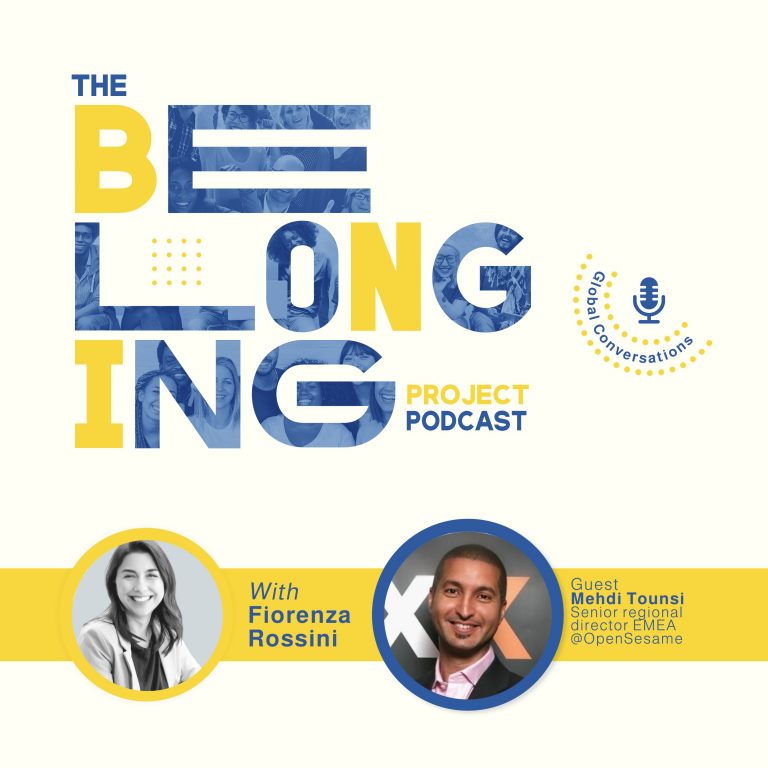
Growing up across cultures as a child of immigrant parents & finding belonging through self-acceptance with Mehdi Tounsi
Read More →Belonging in childhood and adolescence, with Child Clinical Psychologist Dr Sharon Lo.
Read More →