Belonging Project Podcast
Mum Means Business: Motherhood, Ambition & Belonging with Victoria Phipps
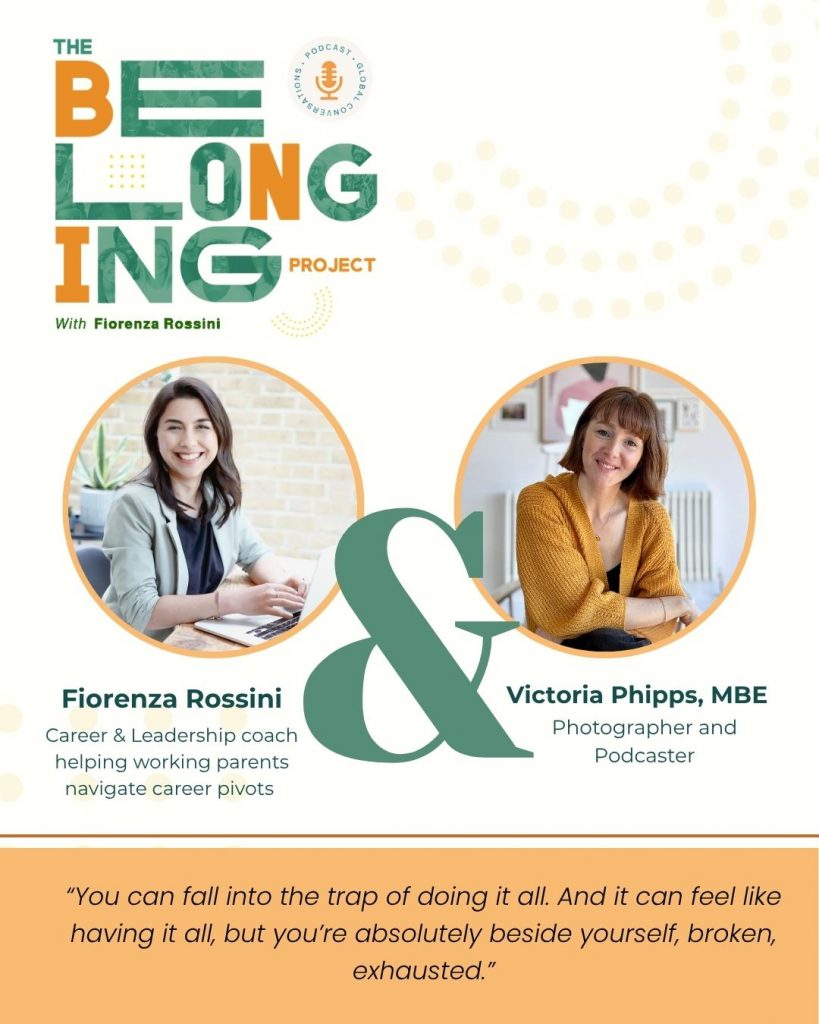
You can fall into the trap of doing it all. And it can feel like having it all, but you’re absolutely beside yourself, broken, exhausted.
From WWII veterans to mumpreneurs: a conversation about ambition, identity, community and belonging.
What connects a group of WWII veterans in Normandy with mums building businesses today?
More than you might think!
In this episode, I’m joined by Victoria Phipps, MBE, photographer and host of the Mum Means Business podcast, for a conversation about motherhood, ambition, entrepreneurship and belonging.
Victoria has spent much of her life creating spaces where people feel connected and part of something. Before becoming a mum, Victoria spent 11 years working with WWII veterans, bringing them together in Normandy for the D-Day commemorations, and building a community around shared experiences. Those years taught her a lot about connection, purpose and finding your people.
We explore how those lessons eventually found their way into her work with mothers building businesses, alongside the pressure to “have it all”, what happens when our old definition of success no longer fits, and why recognising our capacity and protecting our energy matters.
We also talk about something very close to Victoria’s heart: why mothers deserve to be in the photographs too, and how printed photographs can become powerful reminders of identity, connection and belonging.
💡5 takeaways:
- Motherhood can change the shape of ambition without making ambition disappear.
- Belonging and community can be just as important as the work itself.
- “Having it all” can become exhausting when it means doing it all.
- Protecting your capacity is not selfish. It is part of sustaining the life and work you care about.
- You deserve to be present in the memories you are busy creating for everyone else.
⭐⭐⭐⭐⭐ If you’ve enjoyed this episode, please leave a rating and review!
🔗Resources & people mentioned
Victoria Phipps, MBE: Photographer and host of Mum Means Business.
Find her photography work here
Mum Means Business: Victoria’s podcast about motherhood, business and building a life that works for you. Listen here.
Fiorenza Rossini, your host: Leadership and career transitions coach, supporting parents of young children through career growth, leadership and change. Find her work here.
Host
Fiorenza Rossini
Career and Leadership coach helping working parents navigate career pivotsFiorenza started building her coaching business in 2016 while still working in investment banking. When her first child was born in 2019, she knew something had to give. Like many parents, she realised she couldn’t keep growing her career in the same way while also being the parent she wanted to be. Her priorities became clearer, and she chose to leave corporate life to focus fully on her coaching work. Today, Fiorenza supports driven professionals & leaders who are also parents of young children, who find themselves to be at a pivot point - whether that’s returning to work, stepping into leadership, or rethinking what career growth now looks like.
Guest
Victoria Phipps
Photographer and PodcasterVictoria Phipps is a photographer who cares deeply about serving mothers - capturing fleeting memories on film and creating lasting printed artwork that is destined to be family treasure. She is also now a business-building mother - fascinated by the stories of other mothers who are trying to build a sustainable business that allows them to be the mum they want to be AND the live a fulfilled life rich in purpose and yes... profit.
Read Transcription
Victoria (00:00)
I’m kind of coming out or trying to like lift myself out of this era of doing it all.
And slowly but surely it’s starting to sink in, but that’s been quite painful because the stories that I have internalized about having it all are really fixed within me.
It’s been quite fascinating to even notice myself that even though I know I should rest, I cannot in that moment bring myself to. And it’s this toxic productivity cycle that I think a lot of us are getting stuck in because you go straight from busy working day into your mum shift.
And often there’s like no transition.
Fiorenza Rossini (01:34)
Today I’m sitting down with Victoria Phipps, Victoria is a photographer and a podcaster. Her podcast, Mum Means Business is amazing. I am a big fan. Victoria is passionate about serving mothers, whether that is in her photography business, helping them capture memories on film, or whether that’s through her podcasting where she features the stories of other mothers who are trying to build
a sustainable business that allows them to be the mum they want to be and live a fulfilled life and also, yes, profit, make profit. I’m so excited to have you here, Victoria.
Victoria (02:07)
I’m excited. I’ve been really looking forward to this conversation. Thank you so much for having me.
Fiorenza Rossini (02:11)
All right, let’s dive in.
Victoria (02:12)
I’m
Fiorenza Rossini (02:13)
So you have two daughters. How old are they?
Victoria (02:16)
They are five and three. Cute age.
Fiorenza Rossini (02:19)
All right.
Yeah, cute age, but also it’s quite full on.
Victoria (02:24)
Very full
on, still full on. Yeah, I don’t know if the full on ever ends, it?
Fiorenza Rossini (02:28)
Yeah, my, so my kids are six and a half and two and a half similar age, really. and I was just chatting with another mum yesterday and we were saying like, it kind of, it’s really much like, goes through phases, right? It’s, it, it feels very tough. And then you’re like, this is plateauing now. Okay. Yeah. Yeah. I, I’m doing this. I can do this. And then all of a sudden it just goes sour.
Victoria (02:50)
Yeah, completely.
You think you’ve nailed it for like three weeks. You’re, you’re living the dream and you’re winning in all, in all areas. And you’ve got your routine down and everything seems to be working and everyone’s in a good mood and stable. And then something shifts and it is, it’s just navigating that all the time in motherhood, isn’t it? All these different seasons. And obviously like, like you say, it is full on at the moment and there’s still a lot of physical demand. There’s still little, but then, you know, as we cruise.
further down the line into like teenagers, there’ll be all the like emotional demand. And so it’s never really not demanding, I don’t think,
Fiorenza Rossini (03:24)
Yeah, yeah.
Victoria (03:25)
it shifts.
Fiorenza Rossini (03:26)
It shifts, it definitely shifts, yeah. So in your photography work, you care deeply about family treasures and creating family treasures I’m gonna ask you a question and I’m gonna emphasize that this is really a theoretical question. So just please play with me. If your
Victoria (03:44)
Yeah.
Fiorenza Rossini (03:46)
house was…
on
fire and you could only grab one physical photograph that you have at home, what would it be and why?
Victoria (03:54)
my God. Okay. so hard. Because the easy part of that question is what would you grab? And it will be the photographs, plural, but to choose one. There is one photograph that I really love. And I guess if I was in a mad rush, which it sounds like I would be, I would perhaps reach for that one. And it’s a photograph that we have hanging up in the hall.
And it’s a bit controversial because I am not wearing very many clothes in it, but it’s from
Fiorenza Rossini (04:21)
Hahaha
Victoria (04:21)
a maternity portrait session. And it was really hard for me to have those photographs taken because it was COVID. So when I was pregnant with my first baby, with my eldest daughter, I managed to get a maternity shoot in with like two days notice with a photographer that I had not researched. was just who would do it.
like two days before we went into the second lockdown. So November 20. And I just knew that it was really important. And then the next one, I think we were just coming out of a lockdown, everything. We were out of lockdown actually, but there was like masking and all sorts of stuff. And I found a photographer that would do it. And so this photograph, it’s black and white. And it’s me and my big tummy. She actually wasn’t that big because my little girl.
the little one, she’s tiny, like there’s nothing of her. And my daughter, my eldest daughter is just in her knickers and her nappy and she’s, I’m carrying her and she’s kind of sitting on top of my bump and we’re just cuddling each other. So it’s the first photograph with all three of us and my kids call us the girlies. So like daddy’s not in the loop on that one. So it’s the first girlies photo.
And none of our faces are in it particularly, but it’s just the three of us, like our bodies. And I really love it. And sometimes I’m like, most people must think that I’m XYZ, that I have this like black and white photograph of my big fat tummy just in the hall. But I kind of don’t care because I live here and I get to look at it all the time and the kids love it. And I think that is the thing that is why I advocate for print, particularly with family photography, because those photographs kind of become famous.
because you’re seeing them every day. so even now there’s like a little gallery wall that I’ve made in the hall. And I did it probably two years ago and the kids still look at it even though all those photographs are now two years old. And so the little one be like, there’s me as a baby and there’s me with granny and they know the photographs inside out. And I think that really does help with their sense of belonging, like that their identity, that this is their home. They are part of it.
They are valued and treasured here. And I love that. And that’s why I think I lead with print in my photography business, because I want that for other kids and for other parents as well.
Fiorenza Rossini (06:29)
Yeah. And I love how you’ve mentioned about the three of you, the three girls being present, you know, being there in that photo. I think there’s sometimes a little bit of resistance in, you know,
acknowledging that our baby yet to be born still in our tummy is actually there on the picture, right? But they are in such a special way. Yeah. Yeah.
Victoria (06:51)
Yeah, yeah, yeah, yeah, yeah, absolutely. Yeah,
yeah. I mean, she was unavoidable. She was right there, you know. I think there’s a lot of resistance from mothers to have those photographs taken because everyone has different experiences of pregnancy, of course, but you can feel quite self-conscious.
and people might put on weight during pregnancy or they might just, there’s lots of reasons and it’s all to do with how we see ourselves, why a woman wouldn’t want that picture taken. And I think part of my job is to kind of make them understand that they’re gorgeous. Like they are performing a miracle and they absolutely deserve to be in the photograph. Whether that’s a maternity portrait or whether that is,
later down the line with their kids, a lot of people will book a family session or they’ll book a session because they want to capture their kids. Whereas I’m like, actually this is for you too, because I don’t know about you, when I look back at my own family pictures from my childhood, the ones that I appreciate the most and value the most are the ones with my parents. Like it’s cute to see what you look like at that age and it’s a curiosity, but what matters most?
with hindsight when you’re looking back at that time is that connection and that relationship that you had with two of the most important people, know, the foundational people in your life. And I think as well, it’s it’s reframing it. It’s not just capturing your children’s childhood. It’s capturing your motherhood
Fiorenza Rossini (08:21)
Mm-hmm.
Victoria (08:22)
because 20 years down the line, those kids will have flown the nest and you don’t want to just rely on your own memory.
You want to have those triggers, those like physical moments suspended in time that you can look back on. And,
Fiorenza Rossini (08:37)
Yeah.
Victoria (08:38)
and so I really advocate for that.
Fiorenza Rossini (08:39)
To be honest with you, I’m often not in the pictures that are
Victoria (08:43)
Yeah.
Fiorenza Rossini (08:43)
being taken daily because I’m the one taking them. And it is
Victoria (08:47)
Yes, exactly. Exactly.
Fiorenza Rossini (08:49)
so frustrating. And I think it’s something that
Victoria (08:51)
Hmm.
Fiorenza Rossini (08:52)
you’ve mentioned many times online, or perhaps we’ve had a little bit of this conversation already.
Victoria (08:57)
Yeah, I talk about it
all the time. Yeah.
Fiorenza Rossini (08:59)
It’s so important, right, to actually see ourselves as part of it.
Victoria (09:03)
I think we see ourselves as, as the capturers, the curators and the keepers of the family photo archives. And we don’t necessarily ask for that role, but we recognize that no one else is going to do it. And it’s actually a massive burden because we’ve all got these iPhones. We’re taking pictures constantly. And, you know, I’m a photographer. understand about this stuff and I understand about the value of print, but I’ve still got
Over 20,000 JPEGs, iPhone snaps, if you like, that I need to sort through and organize and print. And that is an obscene amount of data. And you know, to go through that, chronologically organize it, put it somewhere where you know it’s going to be safe, back it up. You know, in the same video is a whole other thing. And we’re the ones that feel like we want to capture this moment because we’re putting so much energy into.
creating this beautiful childhood for our kids. We’re thinking about it all the time. We’re the ones that are usually like planning the holidays, the days out, all the stuff. And we’re reaching for our phones when no one else is, when they’re doing something cute. But then there’s the burden of having to actually deal with that. And I talk about as well, there’s this kind of anxiety that I have that I know a few other mothers I’ve spoken to share.
It’s like, what actually happens to those if we don’t print them? Like when we’re in our graves, is anyone going through our iCloud? Like what if the iCloud just goes down? What if the cloud, I don’t know why calling it the iCloud, the cloud, our hard drives, you know, they are limited in that capacity. They only have a particular shelf life and you’re supposed to be moving files around between them like every five years to keep them stable. And we don’t think about this stuff.
Fiorenza Rossini (10:46)
I didn’t know that.
Victoria (10:46)
And I, yeah, exactly.
you don’t. like, I’ve got hard drives full of photographs going back like 15, 20 years. And I don’t do that. A lot of it’s client work that I don’t need to. files around and like opening them. And that sort of refreshes it all because as technology moves on and software develops and advances, you can’t guarantee that these things are going to, you know, if you put a photograph.
onto a hard drive now that in 30 years time, you’ll be able to do anything with it. And I do think that this is like, our kids are probably the most photographed generation, but actually, but actually they could also be to a certain extent a lost generation because what happens to those photographs? Like we have it all on social media, but honestly, sometimes my mind boggles the amount of data that is out there. And like a lot of it is out of our control.
And I just think there is something about having a physical print, an album, like it becomes an heirloom and a family treasure and a thing that can be held and you can connect over it. So yeah, I don’t know, I do worry about it sometimes because it is such a sense of, like I said, identity and belonging that you draw from those photographs. They can be so comforting and so joyful, you know, during…
the darkest days of our lives, we will go to photographs for comfort. If we lose somebody, we’re digging out all the photographs to celebrate their life. And I just really want to help people to become aware that actually one of the best ways that you can preserve those memories of those important people is to actually print your photographs. So I’m on a little mission to sort of celebrate print and the analog.
Fiorenza Rossini (12:26)
This
is the reminder that I needed certainly. But also I think that many
Victoria (12:28)
Hmm.
Fiorenza Rossini (12:31)
will enjoy actually listening to this reminder because it’s important and we often just, it’s something that we know we want to do and we see value in it, but we just push it back at the very bottom of our to-do list. Yeah.
Victoria (12:47)
Yeah, of course. Absolutely,
because we’re busy. Like being a millennial mother in 2026, we are fried. Like there is so much going on. Life is hectic. You know, it’s something that we can easily throw into tomorrow. Absolutely. And I’m guilty of it. Like I said, I’ve got 20,000 photographs. I suppose it’s just to kind of keep it in mind. And if you’re going to invest in those photographs that include you in them as a mum, that’s your opportunity.
to just be like, right, well, we’ve banked these and I liked what I was wearing that day and the kids are having a great time. Everyone’s together, everyone’s happy. Like, let’s just do something with these. And that’s something like, of course, all the other stuff is still there and it’s a mammoth task. I’m not going to sugar coat it, but to have a professional shoot and just outsource that and bank some really gorgeous memories and get them printed.
And then you’ve got that, you know, and it’s something and it just, there’s a bit of comfort to be had from that really. And that’s where I think it’s the photographer’s responsibility to support people with print as well. Not just to kind of hand over the digital files because that’s just adding to this digital burden that mums are carrying around with them anyway. So
Fiorenza Rossini (13:57)
Yeah.
Victoria (13:58)
yes, there’s a lot, but.
Fiorenza Rossini (14:01)
you
Victoria (14:01)
And I don’t
want it to come across like, you know, must go and do this, you know, time’s ticking out and blah, blah, blah, because I know it’s huge. I know it’s a huge task. But at the same time, I understand how important these things are.
Fiorenza Rossini (14:12)
And going back to what you were saying earlier, a printed photo can actually be so helpful in our darkest days where perhaps we
Victoria (14:22)
Mmm.
Fiorenza Rossini (14:23)
don’t feel good, we don’t feel that we belong anywhere, but then we’re able to see ourselves in this photograph and we look happy and then it helps
Victoria (14:34)
Yeah.
Fiorenza Rossini (14:35)
us.
It helps us, well remind ourselves that actually, yeah, we can be happy. We were happy. It’s not just we look happy, we were, and it’s something that we can be again. Yeah, yeah, yeah.
Victoria (14:44)
And we were loved, importantly.
Like, you know, even if that person is not here to love us anymore, and sometimes that is the case, that we have been loved and we were a part of something, even if that thing looks different now, you know, that still exists, that happened, and the photograph in print is proof of that. And I think that’s really precious.
Fiorenza Rossini (15:04)
right, if you allow me to take a step back for a
minute into your career, before you started your photography business, I believe you founded a charity with your dad, working with World War II veterans. Is that correct?
Victoria (15:21)
Yeah, it happened at exactly the same time. So it was like,
Fiorenza Rossini (15:23)
it did. Okay.
Victoria (15:25)
yeah, it was like 2009, both of these things happened simultaneously and quite kind of organically and also unexpectedly, I think. So yeah, they both grew in tandem.
Fiorenza Rossini (15:39)
very different, but at the same time, I can feel the kind of belonging thread perhaps in a way that those two…
Victoria (15:47)
yeah. Yeah. mean, both were kind of passion projects, very different in nature, but both spoke about, definitely about belonging to a certain extent. I mean, one was more kind of about community, but, and the other was more about family, but it is this thing about feeling like you are in your purpose with your people. And I think that is the thread.
And obviously I photographed a lot of veterans. it’s like an overlap there. So photography was a big part of that as well, because I knew that the people that I was with in all our charity work were in the final stages of their lives. And I wanted to photograph them. And, you know, we live in a world where people in their eighties and nineties aren’t necessarily treasured the way that they should be. And, you know, that family.
set up extended family where, you know, the kids come along and they look after the elders is, is kind of fragmented in comparison to how it would have been in centuries gone by. And there were a lot of older people who are really lonely and they’re not necessarily celebrated in photographs as they should be. And so that was part of it as well. And I think the charity work that we did made them feel celebrated.
not just because of their…
heroics, let’s say dramatically, of all that they did in World War II. But because of their wisdom, because of their age, because we kind of embrace them into this family that we created. And I say the word family because it was used so much to describe us by others. So the charity that we built, we’d have veterans coming back year after year and every year felt like a reunion.
We used to take them over to Normandy for the D-Day anniversary. So we’d have this big week long trip in Northern France. And it was like we were in our own little bubble. And it did prompt a lot of friendships
Fiorenza Rossini (17:35)
Mm-hmm.
Victoria (17:35)
and it brought elderly people closer to their children who are, you know, the baby boomers. And I think it surprised a lot of baby boomers how good
they felt about it. I think they entered into it feeling like this was just a thing they had to do. know, dad wants to go, bless him, best go. Can’t take the time off work. That’s a whole week of my holiday, et cetera. And then actually they got so much out of it across the board universally. And I think seeing their parent and sometimes, you know, it’d be their mum celebrated by kind of a whole.
region of a nation and in the press and just being the center of attention really did wonders for their relationship. And it was so fascinating to see that play out. So I suppose the two things, whilst they were quite different, you know, you, on one hand, you’ve got a photography business. At that point, I was shooting weddings. So it was all about, you know, the celebration of this one day event. And I suppose then you’ve got this one week event.
which was the veterans pilgrimage, if you like, to Normandy. But there were a lot of threads that were all essentially to do with people and connection and friendship and family. And the photography played into it because I approached both the wedding and those events in quite a documentary way. And I would seek those moments of connection because I knew that that was what was important to record.
Fiorenza Rossini (19:01)
Hmm.
Victoria (19:02)
And I’m so
glad I have those photographs now because obviously none of the veterans are with us now from our group. We lost our last one about a month ago. So those photographs have appreciated in value in time and are now just so important to me. So grateful to have them.
Fiorenza Rossini (19:17)
How do you feel it has impacted your photography work that you’ve been doing, but that you will be doing forever?
Victoria (19:26)
The charity, how has that impacted it?
Fiorenza Rossini (19:28)
Yes.
Victoria (19:29)
I think it has, and this applies across the board in life generally, I think it has been so enriching in that I was in my early 20s, late 20s, early 30s, across the 11 years that we were actively running the charity, and I was spending an unusual amount of time talking with men and women who were in their 80s and 90s.
think those conversations really shaped me and my priorities. And I was able to benefit from their wisdom. they would, mean, we would have, it sounds all very sincere and serious. It was, of course. And there were times when it was really emotional because they have all these memories from 70, 80 years earlier.
that they would share with us about what happened during the war and what happened in France. And sometimes we would be standing, you know, in a cemetery. There’s one occasion I remember we were just walking through a cemetery and one of the veterans just suddenly felt his knees. And this is a, know, I think at the time he was 90 odd. And he just had been wandering around, minding his own business, just sort of settling in the moment and reflecting. But he saw the name of somebody.
that he had known on this gravestone. And his name was Frankie Keough. That was the name of the chap on the gravestone. And this veteran Bob just felt his knees and he had never known what happened to that friend. And he described him, he remembered him and they had belonged to each other. They had been extracted. I mean, this particular guy, he was a Scouser.
gorgeous Bob Labatee and he had been extracted and put together with all of these other young lads from the UK and basically sent into Northern France. He’d never been anywhere. He’d never been more than 10 miles from his house and just put into Northern France where people are just shooting at them all and they have to fight these Germans and they’ve got like divisions everywhere with big tanks and absolutely terrifying.
And they had to belong to each other, but also they knew that at any moment they could lose each other. And so this particular story had literally been that they were in the grounds of this chateau nearby and there had been a shelling attack. And this kid who was 18 years old was quite, described him as a very sweet boy, but he was out of his depth, like as many were.
And he was frightened a lot and they all looked after him. And he had at one point just jumped over a hedge and a shell had gone off. Literally, and you’re talking like this is, can imagine it. He jumped over a hedge. It’s so simple, but obviously you’re in the context of this war zone. He jumped over a hedge and the shell had blasted and he’d been caught up in it. And so Bob and another chap grabbed him, sort of.
carried him as best they could to a clearing station, And they never knew what happened to him because they had to then go back to the front line and move on. And so he’d always wondered for like 70 years what had happened. And I think then you’ve got this moment where we just happened to be there and he happened to see this grave in amongst hundreds. And he was so overcome with emotion because he’d always hoped that this boy had lived.
Fiorenza Rossini (22:47)
Yeah.
Victoria (22:48)
And he just wasn’t supposed to be there. He was just this kid. He missed his mum, you know, simple things that you can kind of relate to today if you were to send your 17, 18, 19 year old son out into this sort of environment. And he was just a sensitive kid and they all looked after him. They all cared about him. And he just had had this hope for the seven decades that he’d lived. And then this was confirmation that he hadn’t. And I think those sorts of moments.
made me really appreciate life as a whole. And it sounds, I don’t want it to sound saccharine, but these veterans were so grateful to have had this extra seven decades, whatever, some of them made it to eight decades more.
And I think that clarity and that appreciation and the humility and gratitude for life stayed with them. And of course there’s loads of trauma wrapped up in it and they all shared that trauma. And so it bonded them. But at the same time, when they went home, they had to just crack on Everyone was in the same boat. Everyone had their stories.
And I think there was something about getting on with life, getting married, having kids, your own family, getting your own house and this urge to like just rebuild. But then actually when they got to the end of their life, they were ready to reflect. And they had moments of complete clarity that as a 20 something year old, I was able to absorb.
And I think it just taught me that essentially this is all about people. It’s all about connection. It’s all about friendship, gratitude, appreciation. And it made me even more determined in photography to capture those moments
That was so long winded and I didn’t mean to tell you such a long story, but these things shape you, I think. And it’s quite unusual as a girl in your twenties to have that opportunity. And I’m so grateful for it now.
Fiorenza Rossini (24:39)
Yeah,
for a young millennial to be spending time
Victoria (24:42)
Mmm.
Fiorenza Rossini (24:42)
with World War II veterans, it’s a completely different generation. It was a generation who probably wasn’t talking much about their feelings and emotion and what was going on for them. And I feel like those trips that you were organizing for them and facilitating for them perhaps helped them reflect and get…
the closure on, you know, yeah.
Victoria (25:07)
Yeah, hugely, hugely.
And I some of them did feel more able to kind of dig into the emotion once they got to that part of their life, because they had more time and they were in each other’s company. So there’s something about, again, this thing of belonging that they didn’t have to explain anything to each other about what it was like. They all kind of had that foundational understanding.
Fiorenza Rossini (25:31)
Yeah, that shared experience.
Victoria (25:31)
And so they would get exactly, yeah.
And so they would get into the nitty gritty really quickly because they didn’t have to give that context. They were just with other people who got it. And that was a huge lesson. I think in terms of community building, we didn’t set out in that charity to build a community necessarily. I don’t really think.
thought of it in that I think that’s a kind of, I don’t know, it’s a digital thing, isn’t it now that we’re all trying to build community and social media just wasn’t a thing when we started out in the same way. You know, you had Facebook, but I don’t think there was even Instagram. And so you wouldn’t talk about building a community then like you do now in a commercial sense. It was just about taking care of them and making them feel celebrated. And I think appreciated.
And they would joke, know, we’re getting all this attention because we’ve lived a long time. And I was like, well, yes, but also enjoy it for those who haven’t, you know, those who haven’t lived this long, enjoy it on their behalf, you know. And France, the
French people, I know that you are French, so I’m happy to pay this compliment, I want to make a point of it, were so welcoming. And that was again.
reinforcing this idea of community because we made good friends with whole communities in provincial French villages who had residents who remembered when the battle came to their town. And they would come out and just lavish the veterans with attention
Fiorenza Rossini (27:02)
I’m born on a D-day actually. Yeah, I am. And
Victoria (27:06)
really? Are you a Sixth of June baby?
Fiorenza Rossini (27:10)
growing up every year, growing up in France, it was everything was about the World War II commemorations. And of course, as a child, you’re a bit like, hold on, it’s my birthday. But I would say
Victoria (27:21)
I think that’s fair. Yeah.
Fiorenza Rossini (27:24)
though,
even if it was obviously not about me and that’s absolutely fine, there
Victoria (27:30)
Hahaha
Fiorenza Rossini (27:31)
was something that I felt is just the sense of community, right? The community, the country was coming together to celebrate those that were lost and those who fought in a war that maybe they were even too young to understand.
And I couldn’t put words on it, but it was this deep feeling of belonging in a world, in an odd way because I was just a child, but it was just a day where everyone would kind of just get together. Yeah.
Victoria (28:04)
Yeah. Yeah. We
used to go and visit a school in Normandy in a tiny village called Turiaco. And it was kind of getting off a sort of South Normandy. So inland quite a bit, but they had a massive battle there. And the 59th South Staff Division was almost completely wiped out and had to be disbanded. And it was huge for a tiny, tiny village. And they had a beautiful chateau, which was completely destroyed. So can go and see the relics of it.
But every year we would visit this village and from, I think for 10 years, and we would be welcomed with open arms. And we’d start down at this memorial they had at the bottom of this hill, which was like the center of the battle. And we would start there and we would lay a wreath and there’d be school children there. But then we would go up to the people’s memorial. So this is remembering.
villagers, I suppose, who lost their lives in that battle because that happened and that’s really important to acknowledge as well. So you’ve got two sets of people who have lost friends, family members, loved ones, members of their community for this greater good, which is freedom. And freedom is so important. And I think the fact is that everybody understood that 80 years later,
but it doesn’t mean that the loss isn’t felt. And so we would be sat with all the veterans gathered around outside and we would all have, we would have this sort of memorial ceremony and then all the children would go around and give the veterans flowers. And they’ve got so, my God, so many gorgeous pictures of veterans in their eighties and nineties, just sort of patting a kid on the head or someone, a little girl handing a flower to.
a nurse who had been, you know, a QA on the front, just behind the front line. And, you know, trying on their berets, it was playful and
Fiorenza Rossini (29:52)
Yeah.
Victoria (29:53)
it was peaceful and everyone just couldn’t have been happier to be together. And I think that’s something that we always said, you know, and it’s a tricky one because, know, patriotism.
is not the thing these days, particularly in the UK, but we always would comment how wonderful it was that French schools were teaching their kids this stuff about what happened. And the children would write letters to the veterans and send them to me. And I would like distribute them all out, even in the middle of winter and just say, I am so looking forward to hopefully seeing you in June.
just to lift their spirits. And they didn’t know this child and this child didn’t know this veteran, but there will be a drawing, there will be a poppy and they would have written in their best English. And just to think of that intergenerational bond across
Fiorenza Rossini (30:40)
Hmm.
Victoria (30:42)
the English channel.
the foundations of that are really intense, you know, talking about war.
And of course you’re talking about a long time passing. So, you know, people have settled and they’ve processed, but I kind of think this stuff can be done. You know, there is no reason why you can’t bring generations together like that. And it doesn’t have to be that it’s a traumatic story that bonds them. It could be all sorts of things.
And what I learned from that is just how much joy it brings kids and elderly people to just be in each other’s company as well. Because
Fiorenza Rossini (31:19)
Yeah. Yeah.
Victoria (31:20)
these are two ends of the spectrum that have time. You you and I were talking before we started recording about just the relentlessness of motherhood. And I’ve just like sent my daughter off with her dad so that I can record this podcast with you. And you’ve just come out of this period of illness where everyone’s been poorly in your house and
things going on and juggling businesses as well. And like we are in the thick of it right now. This is a busy season. And sometimes our children want our attention and we don’t have any attention to give because we are maxed out. And yet there are these people at the very end of their lives who have all the time in the world and actually to bring them together is so rewarding. And I think there’s…
There’s lots that can be done there. And some of my favorite family sessions have been kind of extended family sessions where you’ve got kind of a great granny and you just get her together with all of her grandchildren. And there might be, know, 15, 20 of them, great grandchildren. And those photographs are so precious because you are talking about generations that span over a century in their experience. And I think that’s just magical, like to capture that, just the humanity of it. This.
kind of shared experience of someone who is coming to the end of their time here and someone who is starting out and the fact that they have that relationship.
Fiorenza Rossini (32:34)
It is truly an
amazing thing. And I’ve been pleased to see more and more intergenerational projects in
Victoria (32:43)
Yeah.
Fiorenza Rossini (32:43)
my local community with nurseries that have some sort of agreement with a local nursing home. And they have those playgroups set up in the nursing home. It’s been lovely to see and I’ve heard amazing stuff about that.
business
Fiorenza Rossini (32:59)
Thank you for being here. I hope you’re enjoying today’s episode. If you want to hear more about this topic, join me on LinkedIn at linkedin.com/in/fiorenza-rossini
Fiorenza Rossini (33:17)
Right, I’m conscious of time. And I want to ask you, how did you move into podcasting? How did you have that idea that you wanted to create a beautiful platform for moms
Victoria (33:29)
Yeah.
Fiorenza Rossini (33:31)
building, having a business and also being the parent that they want to be kind of reconciling those two?
Victoria (33:38)
Yeah, I think it came out of my own maternity experience. I think before I became a mum, we had had this grand finale of the charity work in 2019 for the 75th anniversary of D-Day. And we’d done loads of extracurricular stuff, had big events and it was just, it was fantastic. And then COVID hit and I became pregnant. And during the course of the pandemic, we had other things going on.
We were building this house and I took two maternity leaves and I was kind of busy, but also trying to figure out what my next step was because I had the kind of natural end of the charity and my wedding photography business didn’t seem to fit with motherhood because I didn’t want to be traveling every weekend as I had been up and down the country. And I didn’t really know what to do. And I think if you are ambitious.
And I don’t necessarily mean ambitious in terms of like, want to make loads of money and you want to do, but if you want to do stuff and you have ideas and you have a mind that’s buzzing with creativity, which I know a lot of women do experience after they have their babies, it can be really hard to find an outlet for that. And I floundered around trying to figure out what I would do next because I had to have a business of sorts.
And the identity shift when you become a mother, it rocked me. And I knew anecdotally from conversations that I was having with other women that they had had similar experiences, but also unique experiences because everyone’s bringing their own stuff and we all have our own journey to go on with it. But it’s this thing of like being lost in motherhood in those early days.
the kind of relentless functional repetitive tasks that you’re doing with the nappy changing and the winding and the feeding. it’s a lot. And I really struggled to identify who I was going to be in that. And so I think really that went on for a few years and I did relaunch my photography business. I went all in on family photography.
and I went all in on film. So I decided, right, I am gonna do what I want to do with it. What I’ve always kind of wanted to do, but never felt brave enough. I’m going to take photographs of families on film and I’m going to lead with print and I’m gonna help them to actually create like family treasures. And I was good with all that. I had lots of friends with young children. That all worked fine. And I really enjoyed it, but.
there was just something missing and I realised that it was this community piece and it was this feeling that I had had when I was with the veterans in France, that I was just living in my purpose entirely. I could not have been happier. and I think purpose is so important. And that taught me, that experience taught me and so I was like, just
wondering and wondering and wondering like, is it that’s going to give me that feeling? Because it cannot be that anymore. Those people are not here, but if we could create it once, surely we can create it again. And so I started listening to podcasts. They kept me company through the pandemic in early motherhood. And it got to the point I was like, maybe I could just start one. And this stuff is
So complex, this dance between motherhood and entrepreneurship. And there were so many interesting stories that I was hearing and I wanted those conversations. I think when you’re in early sort of postpartum phases, you, if you’re lucky, you have your mum friends and you’re constantly going for coffee and cake and having conversations. But then that kind of drops off as everyone goes back to work. And I was missing those mum to mum conversations.
And I enjoyed nothing more than talking to another mum who was trying to do something in her business. She was trying to start a business or she had this dream too, or she was doing it and this was working and that wasn’t working. And I just found it fascinating because I think it’s such a unique experience to do these two things in tandem that prompts such personal growth. Becoming a mother and entrepreneurship are two things
that I think force you to look at yourself in the mirror. We really just really get to know yourself again. Did you feel that?
Fiorenza Rossini (37:44)
Yeah, for sure. And I was also leaving behind corporate life when I became a mum or rather when I decided to go full on on my business.
Victoria (37:53)
But that’s a really common experience. Lots of
women will become mothers and You you assume that your baby will just fit into your life as was. And then the reality, you’re like, oh, it’s not, why is it not working? It’s just
Fiorenza Rossini (38:06)
Mm, yeah.
Victoria (38:07)
not. And the logistics, you know, and your priorities shift, you don’t want to be doing like an hour long commute twice a day. You do want to see your baby. And then the childcare costs, it’s just, it’s an absolute.
Fiorenza Rossini (38:17)
Yeah.
Victoria (38:18)
mess of stuff to consider that is all brand new to you. And you’re also learning how to be a mum and there’s no instruction manual. You’re trying to figure that out and you’re trying to recalibrate your relationship with your partner, you know, and also find yourself in it and figure out how you can possibly do something in your working life that earns money and lights you up. Not every day, but some days. And I think
Now it’s quite common for women to look at their old career and think that this doesn’t fit. I need to do something different. And there are a lot of women who are just taking matters into their own hands and they’re going freelance or they’re starting businesses. And I think these conversations are really relatable. think the conversations that I started having once I finally got over myself and launched the podcast.
immediately seemed to land with a lot of mums who were in the same situation. And I really just wanted it to be like a mum to mum chat like we’re doing now, where we just kind of talk about the story of whoever the guest is, you their experience, how, what has this looked like for you? What are your challenges? What’s working well? Where do you want to take it? How is this impacting your family life?
You know, how are you making this all work? Are you making it all work? And I think, I hope that other moms feel safe to kind of open up and talk about it because it’s a lonely experience as well. If you’re working from home by yourself, trying to build something that not necessarily everyone in your real life believes is a good idea, which is sometimes the case, you know, finding your people online is one way that you can feel
less alone. And that is, think where the thread is with all of it. You know, I didn’t, I didn’t know that when we started the charity, essentially we would be helping older people feel less alone and feel appreciated, like they were part of something celebrated for everything that they were doing and had done. And that’s the same thing. It’s like, want mums who are building businesses to feel like they’re not on their own. And I want them
to feel like they are part of a community. And it’s very early days on that front, but it’s building slowly and I’m excited about it.
Fiorenza Rossini (40:26)
I
feel like if I have to choose one word to sum up our conversation or how I’m feeling talking to you right now is community. I would choose that word,
Victoria (40:37)
Mm. Yeah.
Fiorenza Rossini (40:39)
which is also one of my core value, by the way. So I think millennials…
well, millennial mothers in particular, we hear it so often, you can just have it all. You can be the mum you want and you can have the career you want, you can create the business that you want. And I think it’s amazing and it can be a lot. And we already have such a heavy mental load. What do you think about this? What’s kind of…
coming up for you with all the conversations you’re having on the podcast.
Victoria (41:14)
I think it’s about, and this is something that I am still working my way through. I think it’s about unpacking the stories that we were told growing up of all this having it all stuff. We can go out, we can have glittering careers. We can have families and our glittering career. There was never any indication that having a family might have any impact on our glittering career.
Like, and I don’t remember any conversations at school about having children or in university. Like it just didn’t come into it. And I think it’s about not falling into the trap of doing it all because I watched my mum do a lot, but their situation was different. My dad was out. He was an entrepreneur. He had a building company when we were kids and he was
bringing home the bacon and my mum had his dinner on the table and she was taking care of everybody. But she wasn’t also pursuing a glittering career. And I think it is a dangerous trap to fall into. This is as a result, this is forming based on all the conversations that I’ve been having on the podcast. You can fall into the trap of doing it all.
And it can feel like having it all, but you’re absolutely beside yourself, broken, exhausted. And I definitely tried to carry on performing in my work life to the same degree as I had done before when I had my babies, because there was no preparation that I should, no kind of conversation that I had, because my mum didn’t have that experience, because she was
Primarily, she was the nurturer and they had those gender stereotypical roles and it worked really well for them. She didn’t really know how to have that conversation with me. And also, we’re not the same. And that’s where it’s hard as well because my mum is a brilliantly, beautifully contented person. She didn’t feel the need to go and like prove herself in her career because she was confident in herself.
she was like settled, she has that inner contentment, whereas I’m a bit more like my dad and I just wanna do stuff all the time. And I think that is a tension. So I’m kind of coming out or trying to like lift myself out of this era of doing it all. And it is based on conversations that I’ve had with brilliant women on the podcast who have been running a business and raising their children for a long time, who have talked to me about boundaries.
and have talked to me about filling my cup, recognizing my capacity, resting after prolonged periods of hustle. And slowly but surely it’s starting to sink in, but that’s been quite painful because the stories that I have internalized about having it all are really fixed within me. And it’s…
It’s been quite fascinating to even notice myself that even though I know I should rest, I cannot in that moment bring myself to. And it’s this toxic productivity cycle that I think a lot of us are getting stuck in because you go straight from busy working day into your mum shift.
And often there’s like no transition. It’s like you could be on a call on the way to school. You put the phone down, you get your child, and then you’ve got questions, snacks, and you’re into dinner and bath and bed and whatever it might be. You are on from dawn till they finally conk out. And then I think a lot of women really enjoy that next bit of time, which is kind of the peaceful bit when they’re asleep and no one’s asking anything of you.
But then your partner wants some time and you’re just so like, that’s great. And like flop on the sofa, but there isn’t really much time for yourself. And I think we were talking about it before you kind of have to start scheduling it and ring fencing it and protecting it. And I hope that the conversations that I’ve had around this stuff on the podcast kind of help other moms get there more quickly than I have because
I think when we can protect our own energy, protect the asset, we are the asset. We are important. Without us, everything else falls apart. So we have to take care of ourselves and accept that as our own responsibility and move out of that kind of martyrdom space, which mothers have lived in generationally. But
Fiorenza Rossini (45:29)
Yeah. Yeah.
Victoria (45:30)
it’s an active decision that we have to make and it’s a process.
Fiorenza Rossini (45:32)
Yeah,
And I’ve heard many times, mums saying, oh, that sounds like a faff another thing that I have to schedule, right? And I
Victoria (45:42)
Yeah, yeah.
Fiorenza Rossini (45:43)
get how it could be perceived like that. And in those instances, I just say, but maybe you can try it out, see how, you know, if it works, see if you notice a difference. And then if it doesn’t just kind of, if it doesn’t work for you, just fine, it?
between you and I and listeners, my experience has been that if you do take the
Victoria (46:00)
Hahaha
Fiorenza Rossini (46:01)
time, actually you will notice the shift in your patience, know,
Victoria (46:05)
Yes. Yep. Absolutely.
Fiorenza Rossini (46:07)
the patience to actually answer questions and sometimes the questions are wild.
Victoria (46:14)
Yeah, interesting questions.
Fiorenza Rossini (46:16)
Yeah, yeah.
And we need all the patience and energy that we can. Those transitions
Victoria (46:21)
Yeah.
Fiorenza Rossini (46:23)
moments are so hard. yeah, it’s tricky. Realistically, won’t have every day the luxury of scheduling a buffer between work mode and mum mode. But at least if we manage it once, twice a week.
I think it’s a fantastic start.
Victoria (46:44)
Yeah, definitely. And I think there’s a piece in there about just checking in with your body, which I have been rubbish with as well. I think I’ve been quite disconnected from my body during the last few years, but just like, how do I feel? Like, do I actually feel good and energized? Or do I feel like if everyone would just leave me alone for a second, I might collapse in a heap on the floor. You know, what pain do I have? Do I have a headache? Do I need to drink more water?
You know, we can, you know, as mothers, so many stories of like, I needed a wee when I left the house this morning and it’s now 5pm and I still have no time to go. It’s just, we go through this stuff and we deny ourselves like simple human rights sometimes because we are just serving the demands of everyone around us. So I think there’s something about prioritizing yourself and just checking in, which is another thing I’m trying to start to do, but it is all a process and everyone, like you say, some things will fit for some people.
and not for others. It’s just about finding your thing that makes you feel rested and gives you a bit more energy to face each day.
Fiorenza Rossini (47:45)
100%. Thank you so much, Victoria, for this conversation. It’s been amazing. And I feel like we could carry on and talk for more hours, but I’m gonna let you go.
Victoria (47:57)
I honestly, I’ve loved it. I feel a little bit like we’ve really gone around the houses. And I think it’s just like a testament as well to this kind of multi-passionate thing. Like we can have so many different areas of interest. And for ages, I just thought, oh God, I should only just talk about this one thing. I should talk about one thing. Just pick a thing, stay in your lane. But actually our lives aren’t like that. And I really appreciate you kind of indulging me as I wander down memory lane with some of it as well because…
It’s not often I think about that stuff these days and it is, it’s important.