Belonging Project Podcast
Supporting Working Parents: What Every Manager Needs to Know
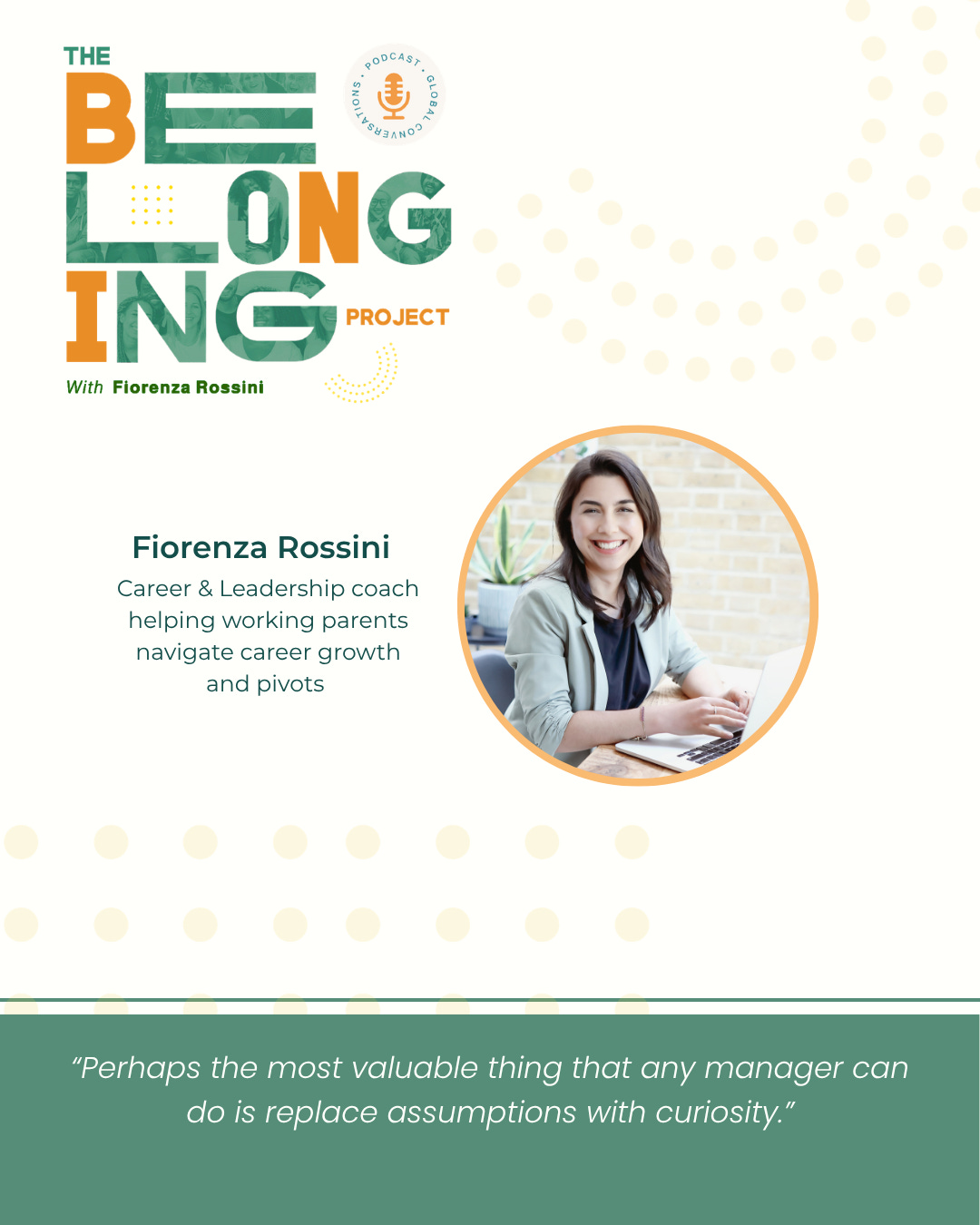
Perhaps the most valuable thing that any manager can do is replace assumptions with curiosity.
What if the biggest barrier to supporting working parents isn’t a lack of empathy, but the assumptions we make?
Most managers want to support working parents. Few have ever been shown how.
What happens after an employee becomes a parent can shape their confidence, career progression and sense of belonging for years to come. Yet many managers are left to navigate these conversations without any real guidance.
In this episode, leadership and career growth coach Fiorenza Rossini explores how managers, leaders and organisations can better support working parents, by creating the conditions for them to continue growing and thriving, instead of lowering expectations.
Drawing on her experience coaching professionals through career transitions, leadership development and the identity shift that comes with parenthood, Fiorenza shares practical insights for anyone leading a team.
In this episode, you’ll learn:
- The common assumptions managers make after an employee becomes a parent
- Why career development conversations shouldn’t stop after parental leave
- How to create a greater sense of belonging for working parents
- Simple leadership practices that help retain and develop talented people
- Questions every manager can ask to better support working parents
Whether you’re a manager, team leader, HR professional, senior leader, or a working parent yourself, this episode will help you rethink what effective leadership looks like during one of life’s biggest transitions.
“Perhaps the most valuable thing that any manager can do is replace assumptions with curiosity.”, says Fiorenza.
🔎 Jump in
03:09 Becoming a parent changes you – that’s just the reality
04:01 The load we can realistically carry has changed
05:28 Don’t assume: ask (aka the power of curiosity)
06:23 Career conversations should never stop
07:32 Visibility or performance
08:54 The importance of small moments and showing up
09:53 Recognising parenthood as a leadership skill
⭐⭐⭐⭐⭐ If you’ve enjoyed this episode, please leave a rating and review
🔗 Links & resources
- Connect with Fiorenza Rossini on Linkedin.
- Explore coaching, leadership workshops and speaking: here
Topics covered:
Working parents | Leadership | People management | Career progression | Parental leave | Employee wellbeing | Workplace culture | Belonging | Inclusive leadership | Talent retention | Career development | Working mothers | Working fathers
Host
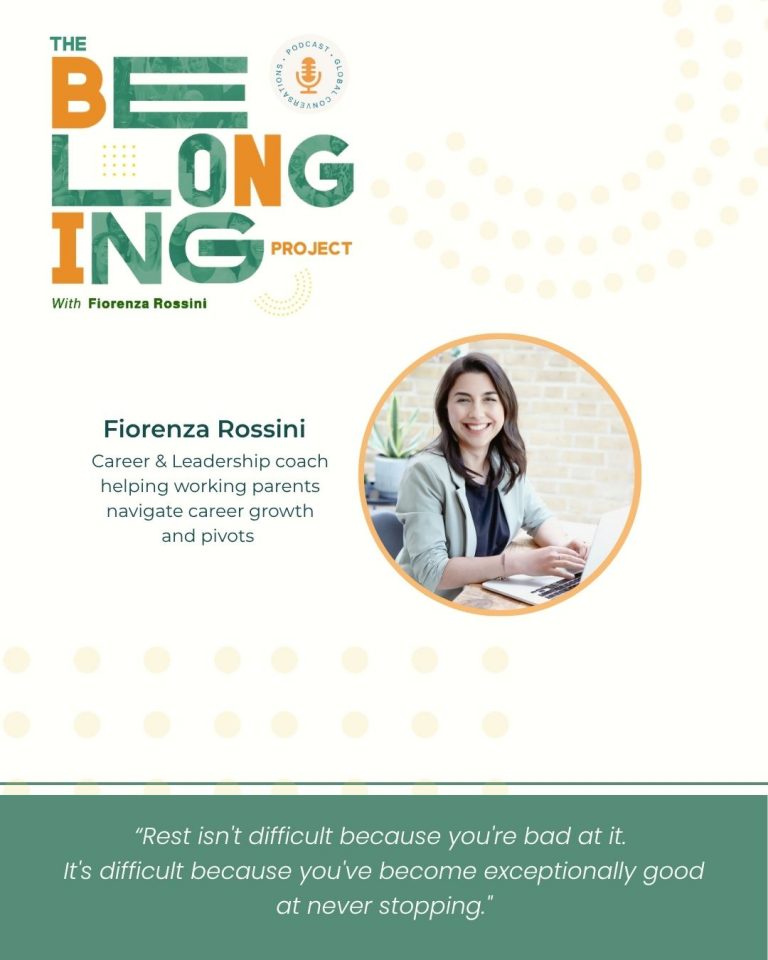
Fiorenza Rossini
Career and Leadership coach helping working parents navigate career pivotsFiorenza started building her coaching business in 2016 while still working in investment banking. When her first child was born in 2019, she knew something had to give. Like many parents, she realised she couldn’t keep growing her career in the same way while also being the parent she wanted to be. Her priorities became clearer, and she chose to leave corporate life to focus fully on her coaching work. Today, Fiorenza supports driven professionals & leaders who are also parents of young children, who find themselves to be at a pivot point - whether that’s returning to work, stepping into leadership, or rethinking what career growth now looks like.
Read Transcription
Fiorenza (00:52)
Hello and welcome back to the Belonging Project Podcast. I’m Fiorenza Leadership and Career Coach, and here we explore what it means to grow, lead, and belong, especially through the life transitions that so often shape our careers. Today’s episode is a little different. It’s for working parents, of course, but it’s also for managers, leaders, HR professionals, and anyone who has responsibility for helping people thrive at work.
One of the things I’ve noticed through coaching is that most managers genuinely want to do the right thing. Most managers actually have empathy. Okay, you might disagree on this one, but you know that’s what I’m noticing. What they don’t have is a roadmap or a toolkit that is fit for the diverse teams that they have. If a leader became a parent not too long ago, or maybe it’s fresh in their memory.
You, as the working parent in that team, you will likely feel seen and heard. You’ll get asked the right questions, and that’s brilliant. That’s just gonna be a brilliant experience for you. But if that’s not the case, so your leader is not a parent or became a parent a while ago, we’re asking managers to support people through one of the biggest identity shifts of their life. Yet very few have been shown how.
So today I’d like to share a few things that I wish every manager knew about supporting working parents.
I want to start with something I hear often in coaching conversations. A client will say something like, My manager is lovely, but I don’t think they really get it. Where does this come from? It comes from the difference that we notice when we come back to work after baby.
Reality is that there’s often less talk about promotions, stretch opportunities, future plans when we get back to work after becoming a parent. Instead, we are now asked about how are you coping? Do you want to reduce your hours? Maybe this project is too much right now. All of these might be well intentioned, but underneath those questions can often sit an assumption
That absumption might be that actually becoming a parent has changed someone’s career goals. And that’s where I think that many workplaces unintentionally get it wrong. So let’s be clear: becoming a parent changes you. Okay? It changes your relationship with time, energy, priorities, success, sometimes with your identity, sometimes with your overall life. Okay. And it would be very unusual if it didn’t.
But change doesn’t automatically mean that, you know, it’s for the worst.
And it certainly doesn’t mean that someone has stopped wanting to contribute. One of the biggest myths that I encounter is that if our parents can’t work exactly as they did before, well then they must no longer be career focused. And I invite us to change that.
Okay, this is probably the biggest message that I want to leave you with today. I’m not gonna use the word capacity here because frankly I cringe when I hear it now. It really makes me think of Chat GPT all over. But while your potential has not changed, the load that you can realistically carry has.
I mean, the truth is that it’s probably doubled now that you have the biggest mental load you’ve ever had at home. And inevitably it changes your load at work too. So let’s imagine someone who used to stay late every inning. They attended every networking event, traveled at short notice, volunteered for every project, and then they became apparent. Suddenly,
They have to leave at 6. ⁓ they have to decline some evening social events, they can travel every month to visit their team overseas, and from the outside, it’s actually easy to conclude that they’ve become less committed to work. But what if that’s the wrong conclusion? Okay? What if they’ve simply become more intentional? They are actually juggling with things.
What if they’re making hundreds of decisions every single day that most colleagues will never see, will never think about, right? For example, who’s collecting from nursery, who stays home with a poorly child? What happened if cool if school calls and says my child is unwell and you have to pick up? Okay.
So, perhaps the most valuable thing that any manager can do is replace assumptions with curiosity. every family is different. Some parents are eager for promotions, others want stability for a little while, some have grandparents nearby, others have no support at all. Some are solo parents, some are caring for children with additional needs.
Two families or no-to experiences are the same. So instead of assuming that your team members’ career goals have changed, please let’s ask. Here are some examples to help you as a leader kickstart this conversation. Number one, what matters to you this year? Number two, what would meaningful growth look like? Number three, what kind of work gives you energy?
The other thing that really saddens me is how many parents tell me that career conversation completely disappeared after they had children. That’s right. They came back to work, and then all of a sudden, nobody asked where they wanted to grow. Nobody asked about leadership aspirations anymore, nobody asked about future opportunities.
Instead, there is an unspoken assumption that they will let everyone know if they want more or if they’re ready for more. Imagine if we did that with anyone else. Okay? of course, I’m a big believer that to get to our career goals, we need to be proactive. Okay? But I also think that part of your job as a leader is to perhaps kick start those conversations.
So development isn’t pausing because someone has become a parent. Okay. In fact, this can be one of the most important moments to have those conversations because of the huge transition that it is and the big changes that come with it. there’s another trap that organisations can fall into. We often confuse visibility with contribution. What do I mean by that? Think about the people who stay late.
The people who join every social event, who reply to emails at 10 o’clock at night, who speak the loudest in meetings. Those people are the people that we notice. Meanwhile, you might have a working parent who is, you know, quietly delivering excellent work, but perhaps leaving also exactly on time every day, skipping some afterwork drinks, perhaps using the lunch break to make
A call to the GP or to call the nursery. What’s changed is their visibility, not their value. I think on this one, a lot of biases, a lot of unconscious biases can show up. So as leaders, it’s definitely one to keep on your radar. And remember that we all have unconscious biases. What matters is what you do with them.
So here are some questions to help you as a leader kickstart this conversation. Who am I noticing? Who might I be overlooking?
Alright, a few a few thoughts ⁓ to finish us off for today. We often think inclusion comes with big policies. We think of flexible working, we think of enhanced parental leave, we think of programmes, KIT days, And all those things matter.
Belonging is often built in much smaller moments. Think about it. Checking in after someone’s first week back. Checking in after someone’s child had a very bad bout of illness. Remembering that this week their childcare arrangement has completely changed.
Recently a former client mentioned the brilliant experience that she had returning to work because her manager was checking in on her and she really made a priority to make sure that she was feeling settled and included.
These moments don’t require a budget, right? They willingness, curiosity perhaps, but also you being attentive.
Okay, final thought is how I really wish that organisations start seeing parenthood differently. So I wish organisations would not see parenthood as something that employees have to manage alongside work.
I really wish that organisations see parenthood as an experience that develops leadership. Think about what parents practice every single day. Prioritising, negotiating, managing and competing demands, especially when you have several children. Communicating clearly under pressure, making decisions with incomplete information, leading with empathy, adapting constantly, and the list goes on.
Those are true leadership skills.
The issue Right now is rarely organisations recognise where those skills have been developing.
If you’re a manager listening today, I’d love to leave you with one question. Who is the working parent in your team that you haven’t really had a meaningful career conversation with recently? Ideas to ask about, where they want to grow, what success looks like right now.
I’m really a big advocate to reduce assumptions as much as possible and replace those assumptions with questions, with curiosity. That’s how people feel seen, trusted, and that’s how they feel that they still belong. Belonging isn’t just good for people, remember, it’s also good for organisations. Thank you so much for listening.
If this episode resonated, I’d be so grateful if you shared it with a colleague, your manager, or someone in HR who is passionate about creating better workplaces for working parents.
And if you’d like to continue the conversation, you’ll find me on LinkedIn where I share reflections on leadership, careers, and belonging after becoming a parent. and if you have the time for a review or rating on the platform where you’re listening to this podcast today, that really would mean the world to an independent podcaster like me. Until next time, take care.
You might also like
Why Rest Feels So Hard for Working Parents
Read More →