Belonging Project Podcast
The Invisible Burden: Why the Mental Load is Motherhood’s Hardest Job
A mother’s brain makes over 1000 micro decision daily. There is no job in the world harder on the human brain, not a surgeon, not a politician, not a lawyer.
How parenthood helped me change my approach to work and life
In this episode, we dive into a topic that resonates deeply with working mums: the invisible burden of the mental load and the necessity of establishing healthy boundaries.
Studies show women spend an average of 4.5 hours per day on unpaid work compared to 2.5 hours for men, leading to stress and burnout.
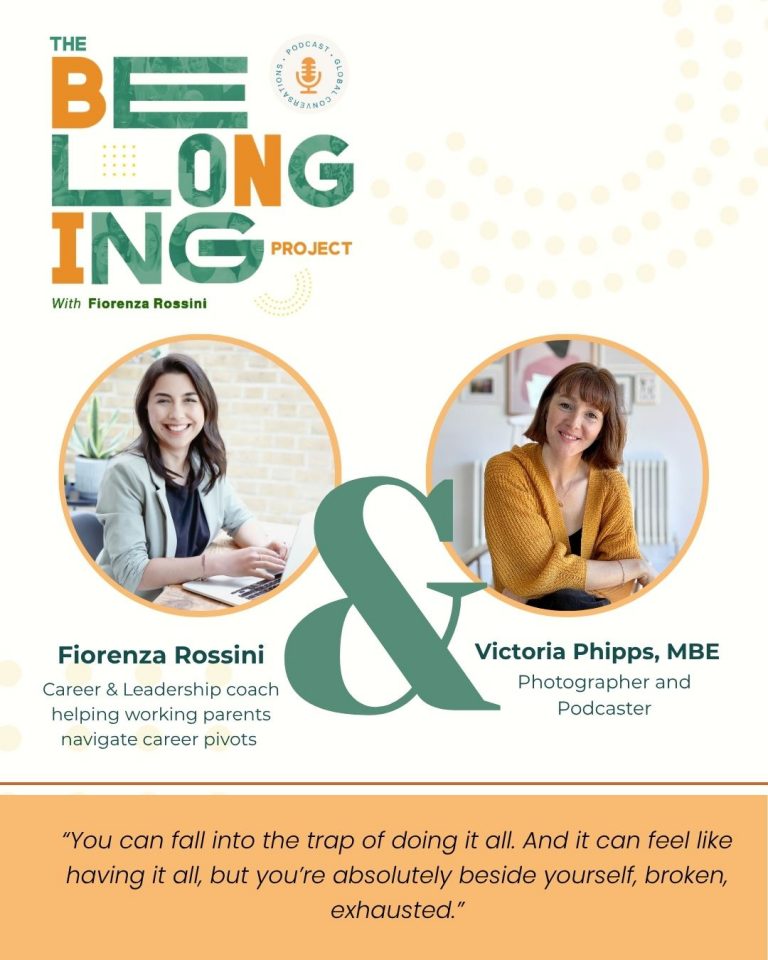
“A mother’s brain makes over 1000 micro decision daily. There is no job in the world harder on the human brain, not a surgeon, not a politician, not a lawyer. Mothering is the only job where the brain never clocks out, even when asleep.” shares Fiorenza.
Fiorenza explores practical strategies to help you reduce this burden, establish boundaries, and create vital space for self-care and creativity.
Key topics explored:
- Defining Mental Load (02:15): It’s the invisible burden of planning, organising, and remembering tasks (from school bags to household chores). It includes the constant thinking and worrying, on top of the execution of the tasks.
- The Mother’s Brain: Fiorenza shares a powerful post from Anna Whitehouse (Mother Puka) (03:42), citing UCL research that a mother’s brain makes over 1000 micro-decisions daily, making it a 24/7 job that never clocks out.
- Sharing the Load – The Big 3 Activity (06:06): A quick exercise inviting you to list the 3 tasks that weigh most heavily on your mind and brainstorm ways to share those responsibilities with your partner or family.
- Practical Strategies for Mental Load Reduction (07:00):
- Communication & Systems: Surfacing invisible tasks and having open conversations with your partner.
- Fair Play Card System: A playful, powerful tool to make the mental load visible and decide who holds which responsibilities. This is a topic from a previous podcast episode with Sam Kennedy Christian.
- Scheduled Check-ins: Conversations should not be a one-off; schedule check-ins to ensure responsibilities remain evenly distributed.
- Establishing Boundaries (08:07):
- Workday Buffer: Create a small buffer (10-15 minutes) at the start and end of your workday to transition smoothly between home mode and work mode.
- Communicate & Prioritise: Be clear about your availability, communicate your time commitments, and practice saying no to tasks that don’t align with your priorities.
- Self-Care & Creative Activities (11:51):
- Separate Self-Care from Creativity: Self-care is about looking after your body and mind (e.g., nutritious food, physical activity like yoga/pilates). Creative activities (e.g., sewing, which Fiorenza enjoys) are for engaging in flow states that boost mental health and often generate ideas for other areas of life/work.
- Prioritise Time: Acknowledge that finding time for creative activities often involves a trade-off, especially on weekends, but keep it on your radar and don’t be afraid to try something new.
- Societal influences, Gender Roles and Expression:
- A study on ScienceDirect suggests that the expression of traditional gender roles (identifying as femme) can influence who takes on more of the mental load at home: not surprisingly, cultural norms often position mothers as the default caregiver.
- Advocacy for policies like shared parental leave helps reduce the gender gap in unpaid work.
- Fostering Belonging: Celebrate small wins, practice self-compassion, and connect with other mums to feel less alone. Community plays a crucial role.
⭐⭐⭐⭐⭐ If you’ve enjoyed this episode, please leave a rating and review!
Host
Fiorenza Rossini
Career and Leadership coach helping working parents navigate career pivotsFiorenza started building her coaching business in 2016 while still working in investment banking. When her first child was born in 2019, she knew something had to give. Like many parents, she realised she couldn’t keep growing her career in the same way while also being the parent she wanted to be. Her priorities became clearer, and she chose to leave corporate life to focus fully on her coaching work. Today, Fiorenza supports driven professionals & leaders who are also parents of young children, who find themselves to be at a pivot point - whether that’s returning to work, stepping into leadership, or rethinking what career growth now looks like.
Read Transcription
Fiorenza Rossini (00:54)
Welcome back to the Belonging Project podcast. Today, we are diving into a topic that resonates with many of us. And the topic is the mental load, or more specifically, managing the mental load and setting boundaries as working mums. It’s a topic that has come up in my previous episode with Sam, Kennedy Christian from the Float Space.
And I wanted to come back to it because it generated some further conversations and it is a topic that comes up a lot. in my life as a working mom and also that comes up all the time in my coaching conversation with clients that are working mums. So if you ever felt overwhelmed by juggling home life, children and a career, please know that you are not alone. In fact, studies show that women spend an average of 4.5 hours per day on unpaid work compared to 2.5 hours for men.
In this episode, we are going to explore practical strategies to help you reduce mental load, establish healthy boundaries, and create space for self-care and creativity. Okay, let’s get started.
So what does mental load mean? Mental load refers to the invisible burden of planning, organising, and remembering tasks. Everything from packing school bags to managing household chores. And if you have primary school aged kids like me, you know that not the same thing has to go in a school bag every day. There’s some days you have to…
Send them with a PE kit and other days you have to put their reading book in or the library books. There is all of this that you have to remember or someone needs to remember it or find a system to remember it. What’s important to note about the mental load is that it’s not just about completing tasks, right? Like getting the lunchbox ready or getting the snacks ready.
It’s about the constant thinking and worrying that comes with it, right? Having to think that I need to remember that I need to get the snacks ready. I have to remember that I have to pay for breakfast clubs, right? All of this is part of the mental load.
Research from the Fair Play Policy Institute highlights that holding too much of mental load impacts mental health, leading to stress and burnout. And when a significant portion of planning and organising falls on one person, often mums, it can negatively influence confidence and wellbeing.
Fiorenza Rossini (03:42)
I am a big fan of Anna Whitehouse, also known as Mother Puka on Instagram. And of course she is a big advocate for women and mothers. And she has recently published a post.
I want to share it with you here and I will link it in the comment section as well. So Anna says, “Why the hell wasn’t I told at UCL say that there is no mentally harder job than being a mother. It’s not a hunch. A mother’s brain makes over 1000 micro decision daily. There is no job in the world harder on the human brain, not a surgeon, not a politician, not a lawyer. Mothering is the only job where the brain never clocks out, even when asleep. Think of it like a system that never switches off with tabs open and apps running all at once. And yet there are still those who ask, what does she do all day? CEOs are applauded for high-stake deals, managers are rewarded with bonuses and corner offices.
Mothers carry more responsibility without teams, titles, salaries, or breaks. With a boss who is on 24-7. UCL says, our brains cut back in other areas. I couldn’t get past one page of a book, says Anna. And I would find myself numbly standing in front of the fridge wondering why I was there. When I needed butter, seconds before. I wasn’t just tired, I was losing parts of my mind to keep everything else okay. Actual help isn’t asking what can I do to help. It’s making packed lunch, it’s wiping surfaces, it’s picking up the kids and clearing the decks. And please God, it’s not doing her a favor or helping out”.
I just love this post that Anna has written. And ⁓ well, I think it does illustrate ⁓ what mental load can look like and feel like. And there is a lot to it. And I think it is really important to
acknowledge and to talk about in your conversation with your partner that there are different aspects to the mental load. It’s not just about the doing and the executing. There is also the thinking, the planning, and of course the executing. And the three things can have different here I want
to suggest a quick exercise that you can do in your own time, feel free to try this right away or later on with a lovely notebook and or not just a piece of paper with a cup of tea or coffee. So
Take a moment to list three tasks that weigh heavily on your mind. Now think about how you can share these responsibilities with your partner or family.
List all the ways that come to mind. This simple reflection can indeed be the first step towards lightening your mental road. And after this episode, I encourage you to have a conversation with your partner about how you can better share household responsibilities. It might feel awkward at first, but it’s a crucial step towards a more and fulfilling life.
Balancing motherhood, mental load and work demands is undeniably challenging. But with conscious strategies, clear communication and societal shifts, it’s possible to find more ease and belonging. Remember, the goal is in perfection, it is progress. Take the first step today to help you. Start a conversation with your partner or carve out a moment just for yourself.
Your well-being and sense of belonging are worth it.
Fiorenza Rossini (07:26)
In my recent episode with Sam Kennedy Christian, we did talk about this and we did talk about how much sharing the mental load or just distributing the mental responsibilities can significantly reduce stress and improve our mental health. And then also our sense of belonging and it can improve our wellbeing massively. And really it all starts with surfacing those invisible tasks.
and having open conversation about them. we talked about the Fair Play Card system.
such an amazing, playful yet powerful way to make invisible mental loads visible. So I would really encourage you to have a look and have a listen to that episode for sure.
The next thing that I want to invite you to consider is establishing boundaries around work and your personal life. So really, I want to invite you to have a clear start and end time for your workday. And you might want to consider including a small buffer at the start so that you are able to switch from home mode to work mode, right? You allow yourself to transition into work mode. And same thing at the end of the day, right? There’s nothing as stressful as going from a meeting or a call you’re having, especially when stakes are high, straight into pickup mode ⁓ from school or nursery. It just, the shift in… persona in how we are and how we want to be just takes a lot of mental gym and especially on days where we might feel tired or let’s be honest sleep deprived it’s not easy. even the smallest buffer that you can give me and that you can give yourself I’m talking 10 minutes, 15 minutes here right? It’s gonna be really helpful just so that you give yourself some space and time to transition, into your next kind of block for the day.
All right, so the other thing is communicate your availability, right? What are time commitments that you have? Be clear about that, communicate. And say no to tasks that don’t align with your priorities. This is clearly an invitation to reduce as much as possible.
Any people pleasing trends and I feel like we should do an episode about people pleasing. So yes, ⁓ this is on the list. according to a study by the American Psychological Association, women who bear the brunt of household responsibilities are more likely to experience anxiety and depression.
Fiorenza Rossini (10:02)
I also wanted to dive into something really interesting that I just came across in an article on sciencedirect.com. It’s how our expression of gender, like identifying as femme, can play a big role in who ends up carrying the mental load at home. this study really got me thinking and
it talks about how traditional gender roles and expression can influence who takes on the mental load. And it’s not just about who does the chores, but also about who’s expected to keep track of everything. So the study points out that people who express more traditional gender roles, like those who identify as femme, might end up taking on more of the mental load. Why?
because society often expects them to be the ones managing and organising family life. It’s like this invisible expectation that just kind of happens. So this got me thinking about how we can shake things up a little bit. If we can recognize how gender expression influences this dynamics, maybe we can start to change things up and share the mental load more thoroughly.
It’s sort about having those conversations and challenging the norms that say one person should be the default manager of everything. So here’s a little challenge for you. Take a moment to think about how gender roles and expression might be affecting who does what in your home. Maybe have a chat with your partner about it and see if there are ways that you can mix things up and share the load a bit more evenly.
Fiorenza Rossini (11:32)
Thank you for being here. I hope you’re enjoying today’s episode. If you want to hear more about this topic, join me on LinkedIn at linkedin.com/in/fiorenza-rossini .
Fiorenza Rossini (11:50)
Please don’t forget to prioritise self-care and creative activities. Okay,
so here I wanna pause and I wanna mention that
I personally separate those, right?
So ⁓ by self-care, I mean, how am I taking care of myself, of my body, of my mind? And for me, this is, you know, making sure that whatever is in our fridge is nutritious enough. It’s not just all beige, of course, what we’re eating. So that’s very important. And that’s way of looking after myself.
And also, you know, working out, adding some physical activities, whether that’s yoga, pilates, whatever that is for you and that works for you. But making sure that I plan for this is very important for me and that is part of my self-care. And also, it really boosts my mental health. On the other side, I also like to take some time for me.
And that’s where I like to engage in some creative activities. My big hobby, as some of you may know, is sewing. And that is really a hobby that I very much enjoy. I like the planning, I like everything about it, all the steps. yeah, having, you know, a finished project is something that I very much enjoy. And when I am in that creative space, there’s just a flow about it, which actually often also
gives me amazing ideas that relate not to the sewing, but to my coaching work, my business, things that I wanna even create for the podcast, right? I will get some ideas when I’m in my creative flow or after I’ve been in my creative flow. Now that’s probably for me personally the hardest when it comes to boundaries because…
When do I have the time to do or to engage in such creative activities is at the weekend and often it’s a trade-off. It’s a trade-off between spending time with my partner who is very much working in the office every day. So it’s a trade-off between spending time with the family, my partner and kids and then engaging in my creative activities where it’s kind of, you know, filling up my cup, my creative cup. And yeah, it’s a trade-off and there are…
There are days, there are weekends where I decide that I need to prioritise myself and others where I actually don’t and I decide that I prioritise spending time my family. So there’s no right or wrong answer, but please keep it on your radar. Make sure that you do have some creative activities that you can engage And please don’t be to try. Try something new.
You might also like
Moving and living across the globe, managing culture shock with Kerstin Graebner
Read More →