
Belonging Project Podcast
The assumptions we make about working mothers, with Ceci Hajredinaj
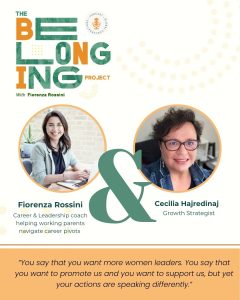
“Calladita te ves mas bonita” In Spanish, this means “You look prettier when you’re quiet.”
Unlearning “calladita”: what we’re taught about being a woman, a mother and having a career.
When I sat down with Cecilia (Ceci) Hajredinaj, there were moments when it felt like I was speaking with a future version of myself: a Fiorenza with teenage children, further along her own journey of unlearning, reflecting on how we become better humans and what we model for our children.
Ceci moved from Honduras to the US at 16, navigating a new country, culture and way of life. She remembers her childhood in Honduras fondly, particularly the strong sense of community around her. She had a village.
When she became a mother in the US, she experienced something very different.
The village she had grown up with was not there. For much of her daughter’s early years, the core support system was Ceci and her husband. She talks openly about the guilt she experienced as a working mother, the mental load of managing family life, and the challenge of making space for her own career ambitions alongside motherhood.
Ceci describes being passed over for promotions and projects because senior leaders made assumptions about what she would want or have time for, now that she was a parent… rather than asking her. While the flexibility was there, it did not mean equal opportunities for career progression were there.
We also talk about the cultural messages that can shape how women show up at work.
Ceci grew up hearing:
“Calladita te ves mas bonita”
In Spanish, this means “You look prettier when you’re quiet.”
What happens when a message like that stays with you?
What does it teach us about speaking up, ambition, leadership and what women are allowed to be?
And what do we have to unlearn later in life?
This poses the question: What messages did we absorb growing up about what women are allowed to be?
⭐⭐⭐⭐⭐ If you’ve enjoyed this episode, please leave a rating and review!
In this episode, we also discuss:
💡What workplaces still don’t fully understand about working parents, including
- the emotional and financial impact of childcare
- why flexibility matters, particularly during the early years of parenthood
- the assumptions that can affect working mothers’ career opportunities
- psychological safety and feeling able to speak up
- the importance of community and belonging at work
- why working parents want understanding, not lower expectations for their careers.
📚 Key topics:
🔗 Cecilia Hajredinaj
Cecilia has a non-linear career journey across client-facing roles, sales and marketing, operations, people operations, learning and development, coaching and consulting. Today, she brings that generalist perspective to her work supporting leaders and mission-driven organisations.
And perhaps fittingly, unlearning has become a central part of her work. Ceci talks about why leaders sometimes need to unlearn old behaviours, habits and assumptions before they can genuinely learn something new.
Connect with Cecilia on Linkedin: https://www.linkedin.com/in/ceciliahajredinaj/
🔗 Fiorenza Rossini, your host
Host
Fiorenza Rossini
Career and Leadership coach helping working parents navigate career pivotsFiorenza started building her coaching business in 2016 while still working in investment banking. When her first child was born in 2019, she knew something had to give. Like many parents, she realised she couldn’t keep growing her career in the same way while also being the parent she wanted to be. Her priorities became clearer, and she chose to leave corporate life to focus fully on her coaching work. Today, Fiorenza supports driven professionals & leaders who are also parents of young children, who find themselves to be at a pivot point - whether that’s returning to work, stepping into leadership, or rethinking what career growth now looks like.
Guest
Cecilia Hajredinaj
Growth StrategistRead Transcription
Fiorenza Rossini (00:52)
Thank you for being here. I hope you’re enjoying today’s episode. If you want to hear more about this topic, join me on LinkedIn at linkedin.com/in/fiorenza-rossini
Fiorenza Rossini (01:11)
Today I’m joined by Ceci Haradina. Ceci has worked in L &D and people business operation at Morgan Stanley for six years and then worked for 15 years in a family-run business as people ops, marketing and finance. Lots of hats there and we will dig into this today. And two years ago, she started…
her own consulting practice supporting leaders with L &D, organizational development and effectiveness, primarily in mission-driven organizations. Hi, welcome.
Ceci H. (01:42)
Hi, Fiorenza.
Fiorenza Rossini (01:44)
I want to start with a little bit of a fun question
a taster probably of you and who is Ceci so in our pre podcast conversation you described yourself as a human trying to human well
What does that look like for you, practically speaking?
Ceci H. (02:05)
Practically speaking, that’s a good question. I would say it is, lately, it has been about just being much more open and curious about the human condition, right? Like, how are we processing information now? How are we communicating and connecting with each other now? Being very reflective, like I’ve been in a very reflective season.
So how can I be a better human? Which in turn allows me in a way to show my daughter how to be a better human. Right? Because I’m leading in a way for her as well. So I’ve been doing a lot of introspective work as well, which I think in a way ends up showing others another side of me that perhaps
I wasn’t so comfortable showing in the past.
Fiorenza Rossini (03:02)
You mentioned you have a daughter how old is she?
Ceci H. (03:04)
I have a daughter, she’s 16.
Fiorenza Rossini (03:06)
Right, so you’re in the teenage years, is that fair to say.
Ceci H. (03:11)
I am definitely in the throw of teenage years, which includes learning how to drive. She got her first part-time job recently after school, which is fantastic. So I am on that stage of her growth.
Fiorenza Rossini (03:25)
So what kind of parent are you when you’re teaching her to drive? Calm and patient or not?
Ceci H. (03:32)
Interestingly enough, I paired my husband with her. Yes, and I did that intentionally because he works a lot and he works a lot on the weekends as well. So I saw it as an opportunity for them to actually have some dad and daughter time and get to know each other and build on those memories. So I’ve kind of forced that on them. And yes, I’ll drive with her a few times. And yes,
I find myself holding onto that handrail, a little harder than I would otherwise. But you know what? She’s actually pretty good. Like she’s serious. She’s focused on where she’s going and what she’s doing.
Fiorenza Rossini (04:12)
I also learned to drive with my dad and I think I’ve never, I never had seen him hold himself to the handrails so hardly.
Ceci H. (04:25)
I mean, and in the back of my mind, I’m always like, okay, just let her do her thing. Don’t say anything. See what she does first before you actually like let out a scream or say stop.
Fiorenza Rossini (04:36)
Yeah, yeah, absolutely. So, you live in New York, but you have not grown up in New York. You grew up in Honduras.
Ceci H. (04:44)
Yes, I was born and raised in Honduras until I was 16 years old. And then my dad’s job brought us all the way to New York and that was Syracuse, New York at the time, upstate New York. So that was a big, not only climate change for me, but also a big environment and cultural change as well.
Fiorenza Rossini (05:10)
Hmm. And as a 16 year old, you add this big chapter in your life where you are getting to get a sense of who you are, your identity, and then you get to be in a different country, different culture. What memories do you have of perhaps growing up in Honduras first, if we start with that?
Ceci H. (05:33)
My memories of Honduras are in a way very magical. I grew up in an environment where there was a lot of family around. Aunts, uncles, cousins, right, grandparents. It was a small town, so neighbors knew each other. And it was, you know, that phrase of it takes a village, right? I felt that growing up there.
So I feel really blessed that I had the opportunity to have that type of an environment to grow up in. Now, if I fast forward to when we moved into the States, completely different. We didn’t know anybody. I had to make new connections, make new friends. I was fortunate enough that
my school I felt was pretty welcoming. At least I didn’t feel like I was an outsider. They didn’t make me feel that way. I made some pretty good relationships there, a couple which I have still maintained. We still keep in touch.
Fiorenza Rossini (06:39)
Wow.
Ceci H. (06:39)
So that was great, yes. But there was definitely that almost day and night, right, of having grown up with a lot of family, a lot of community.
to not really having anyone. And that goes for my parents too, right? Now they were raising me in this new environment. My sister was out of the house by this point in time. She’s nine years older than I am. But they didn’t have a lot of people to rely on, right, in this new environment. So that took some adjusting for them as well.
Fiorenza Rossini (07:11)
How was the cultural adaptation? I’m not too familiar with the culture in Honduras, but my assumption is that it is very different to the cultural norms, cultural values that typically you associate the US with. How was your experience about that?
Ceci H. (07:32)
Well, the culture in Honduras is, at least from my perspective and what I grew up around and was very much a.
I I’m generalizing here, but it was very much what you would think a Latino sort of environment and culture would be like, The man goes to work, the women largely stay at home caring for the children. All of that was, I was seeing that, but at the same time, I was also seeing
women who were pushing the boundaries and were opening up their own businesses and were deciding right that they did want to work and they were finding work that they liked. And although my mom didn’t have a paid job, right, she volunteered a lot in our community, right. So I grew up around that too, right. She would volunteer with
sometimes organizations from the United States that would go there to support the poor and the underserved. And she would work with them on that or the churches, right, or local villages around. So I grew up with that side of it as well. So definitely some machismo going on there, right, definitely that idea of if you have a family and you have children as a woman.
it is really your duty to take care of that family nucleus. Coming into the States, it was eye-opening for me to see that that’s not really how families worked here. Right here,
Fiorenza Rossini (09:13)
Mm.
Ceci H. (09:14)
usually both parents were working. They were working with each other on
whatever, however their schedules were gonna work. They had, know, babysitters or daycares or nannies, right? All that type of stuff happening. so it was interesting to sort of see that type of environment play out when I would visit my friends’ houses or, right, just being around in the community. It was…
just an eye-opening experience, right, to see, this is another side of how people relate to each other, right, sort of have passions and interests that they wanna pursue. And it seemed much more open and liberal in a way, right, especially
Fiorenza Rossini (09:58)
Mm.
Ceci H. (09:59)
as a woman to know that there were bigger opportunities here.
for me to be able to pursue.
Fiorenza Rossini (10:07)
Yeah. Yeah. Yeah.
How did you find your way into L &D?
Ceci H. (10:13)
Oh, good question. know, learning and development was a thread that I had throughout most of my career, right? All the time that I spent in corporate America, whether when I was at Citi or PricewaterhouseCoopers or Morgan Stanley, I naturally leaned into that type of work. And I think largely it was because
social impact is a huge motivator for me. So I naturally lean to supporting others that I felt were falling through the cracks or were underserved and trying to help them overcome whatever gap, right, or challenge they were facing in their career. So I would mentor, I would coach individuals, I would, right,
design a training plan for our team. Like I was naturally doing those things. And I’m big on learning, right? I’m an avid learner. That’s just how I’ve always been. But I didn’t formally get into it until I was at Morgan Stanley, when that opportunity came up for me to actually lead that line of business where I was gonna be engaging with
these business coaches, these external right third party coaches. That was a huge eye opening experience for me right to be able to see the work that they were doing and the impact that it was having on the employees that they were working with. And from that it was, I want to get certified as a coach and I want to start doing this more formally and I want to start designing and
executing leadership development programming. And I was paying attention to how some of these other coaches were leading these programmings and noticing things like this one is much more impactful than this other one. And I started doing the analysis, return on investment and a lot of these things. And I loved it. To me, that was like, wow, okay, I…
I kind of knew in the back of my head that these were things that I loved, but now that I’m doing it, it just reinforced it. And I said, okay, yes, I definitely want to continue doing more of that.
Fiorenza Rossini (12:34)
So it sounds like it’s been several key moments that led you to get a confirmation that it was the path for you.
Ceci H. (12:44)
Yeah, for sure. was, you know, my journey has been interesting because I haven’t, although I have spent a lot of time in corporate America and in financial services. I moved around a lot. Like I have a very broad range of having sat in client facing roles, having learned sales and marketing, having learned operations.
the HR, right, people operations side of things, the training and development side of things. And within all of those things, right, I gained skills that got me to this point where I am now, which I personally think is really helpful because when I’m developing a programming or I’m coaching someone, a lot of times I can say I’ve sat in that seat, I’ve been there, right, I’ve been a client service.
professional, I’ve been a marketing professional, I’ve been in HR, right? I understand a lot of what that function entails in order to support them more effectively, right? Which whatever vision, right? Or goal they have in mind for their career.
Fiorenza Rossini (13:56)
Mm.
Ceci H. (13:56)
So it’s been, it’s been great, but yeah, I agree with you. wasn’t, none of it is really linear, I think for most of us. But I think I needed to sort of have that.
path and gain those skills and that knowledge in order to make me hopefully a better L&D practitioner, a better coach, and a better advisor and consultant right to my clients.
Fiorenza Rossini (14:21)
Tell us a little bit about what you do now and with your consulting and coaching practice, what does that look like for you?
Ceci H. (14:29)
It has definitely evolved. When I first launched it, I was of the mindset that I wanted to continue to support a diverse group of people, the people who generally fell through the cracks, right? Help them reach that next level in their career, help them decide if they needed to pivot to something else. So it was very much a
one-on-one sort of leadership coaching lens. But as I started to work with individuals, I realized that as much as I love that, I am also very strategic in my thinking, right? I think big picture, I’m
Fiorenza Rossini (15:12)
Mm.
Ceci H. (15:13)
thinking about this is where this team or this organization is.
these are the gaps that they have and this is where they want to go. So I felt like I was sort of limiting myself by just doing one on one. So I went broader into, okay, I can actually get into the talent strategy of an organization, right? The organizational effectiveness of that. So I started doing some of that. And because I love nonprofits and the social impact space, I started working with
small to medium organizations in that space. And I found myself just in a perfect alignment of two things that I love, learning and development and mission driven work. So I’ve been loving it. And interestingly enough, because I have a generalist mindset, right? It’s sort of a broad range of things. I can tap into all of that And support
an organization with challenges that they have beyond learning and development.
Fiorenza Rossini (16:20)
And talking about touching on a wider range of things and skills, you’ve worked for your family run business, for your own family run business for more than a decade. And you were wearing several hats. How was that for you, the juggling?
Ceci H. (16:39)
That has actually been really great. When my husband decided that he wanted to formally go off on his own and have his own general contracting business, I was the one that helped him set that up. So we actually co-own that business. And he’s had it for over a decade now, but there’s a lot that goes into formalizing a business.
so I helped him through some of that and I mean, he does 90 % of the work, right? They’re definitely the manual work that goes into right. Renovations of offices and apartments and all that good stuff. so the part that I do is more behind the scenes is making sure that. Right. We’re getting invoices out on time that we’re getting paid on time.
When we need additional staffing where he needs additional workers, I’m helping him hire some of those of those people But even as the business has matured I’ve had to think about how can we Automate some of these things. How can we make them right more efficient streamline? So even something as simple as QuickBooks right has become really beneficial for that organization, so
I would say I don’t spend a lot of time in that. It’s more, there’s ebbs and flows of when I need to sort of be a part of that process. But it is mostly a business that my husband runs.
Fiorenza Rossini (18:09)
Thank you for being here. I hope you’re enjoying today’s episode. If you want to hear more about this topic, join me on LinkedIn at linkedin.com/in/fiorenza-rossini
Fiorenza Rossini (18:27)
And going back to your experience in Corporate America, I’m curious if there’s anything you’ve observed in terms of
workplace behaviors, around inclusion of working parents or belonging for working parents that you’d like to share with us. It could be things that worked very well or things perhaps that you’ve worked on or things that perhaps you have ideas or opinions
on.
Ceci H. (18:55)
You know, if I, when I think back to when I first had my daughter, I would say that one of the bigger benefits of that time was that companies were becoming much more open to flexible work schedules, like remote work, right? And that type of stuff happening. So I was able to take advantage of those opportunities.
Fiorenza Rossini (19:24)
Mm. Yeah.
Ceci H. (19:25)
in my own life, which
was very beneficial, right? Because at the time where we were living, was dropping her off at daycare, taking the bus that took me to the train, taking the train into the city, right, to get into the office. And it was, it wasn’t a short commute, but aside from that, I felt really far.
from where she was spending most of her time. And that came with a lot of guilt, a lot of, right, I’m the mom, I should be raising her, right, she’s basically being raised by strangers. So I had to, I was battling sort of with that guilt and that sense of, I don’t get to see her all the time as I would like to.
But then on the other side of that, also was fortunate enough to work with leaders who were also female and also parents, right? So they knew what this was like. So there was a lot of flexibility there of, I can just work from home this day or, right, she’s not feeling well, I’ll stay home and I’ll be able to just be there with her. So I was glad that I had
those opportunities. I think that where I saw disadvantages was in
promotions in career growth where sometimes senior leadership would say or would think or assume for that matter that because I was a parent now that I didn’t want to grow in my career or I wouldn’t have the time to do that
Fiorenza Rossini (21:06)
Hmm.
Ceci H. (21:07)
now. Or how was she going to balance both things now? So they were making decisions without
me being a part of that decision making process. Right. And I was getting passed over for promotions or passed over for a project that I wanted to take part in because they were assuming that I wouldn’t want to do it or I wouldn’t have the time instead of asking me about it.
Fiorenza Rossini (21:34)
When you were in the moment, how was it for you?
Ceci H. (21:38)
In those moments when I was at work,
Fiorenza Rossini (21:40)
Yes.
Ceci H. (21:41)
you know, I think that it was right. That feeling of you say that you want more women leaders. You say that you want to promote us and you want to support us, but yet your actions are speaking differently, right? To what you’re saying. Right. So then it would make me feel if anything excluded, right? I would feel excluded from.
that process or excluded from that opportunity. So it was feelings of right imposter syndrome, feelings of not being worthy, feelings of right this person is getting it but I’m not. So I think I, right you have all of that coming through.
And then on the other side of that as a mother, I was thinking, right, I still need to be able to provide for my family. I still need to work, right?
Fiorenza Rossini (22:32)
Mm.
Ceci H. (22:33)
So I would stay silent, right? So there was that, okay, I’m not gonna ruffle the feathers and I’m just gonna keep doing my work and I’m gonna do it well. And some recognition is gonna come from that. And right, that was fine.
Fiorenza Rossini (22:46)
And right now, looking back, what do you see? What could have helped you in the moment?
Ceci H. (22:53)
I think what could have helped me would have been to have had better advocates and better sponsors, right, within those relationships that could really in a way speak in those rooms where I wasn’t necessarily in. But I can’t point the finger outward.
much either. Right? Like I have to own my own career and the vision that I had. Right? So was there more that I should have done? Probably. Should
Fiorenza Rossini (23:26)
Hmm
Ceci H. (23:27)
I have spoken up more? Yes. Should I have been more intentional about who I was creating relationships with and how I was fostering those relationships? Especially those that had that power, right? To be able to
shift change and to create decisions, sure. But I just, for whatever reason, I just wasn’t ready at that time to do that.
Fiorenza Rossini (23:55)
And I think that in order to speak up, or do more, especially when we are in a delicate moment of time, we need that psychological safety to be present, to feel safe to do so.
Did you feel safe to speak up?
Ceci H. (24:16)
I felt safe to speak up with certain people and in certain rooms. So it wasn’t across the board.
Like you would almost put on this business face on and say, okay, I have to act this certain way. And these are the types of sort of behaviors that they’re looking for. So I need to model those types of behaviors, right? When I’m in these certain rooms with them. And I think beyond that, there was this…
cultural piece to it, having grown up in a Latino household and community where women were not expected to speak up.
Like in Spanish, we have a saying that says, calladita te ves mas bonita. You look prettier when you’re quiet.
And that was sort of that environment you grow up seeing that from your elders. And then what are you doing? You’re learning from that. And that’s the behavior that you’re modeling, right? Is, I’ve been told that I really shouldn’t be speaking up.
Fiorenza Rossini (25:24)
What’s the impact that this had on you and on your family perhaps, growing up with a phrase, right? Such a phrase kind of being present somewhere in the background.
Ceci H. (25:37)
It was, yeah, was always there. And it was always there in those moments where I really wanted to speak up and I wanted to say something, whether it was about myself or something else that I had seen or heard. And I just did not have the confidence or perhaps the willpower at the time to do that. So yes, absolutely.
I mean, did it cause me to not take part in certain opportunities? it, right? Was I not seen or heard because of it? Probably, yes. But no regrets, no regrets. think I had my own life journey to go through my own lessons that I had to learn. I had to sort of learn that and be able to unlearn that behavior
and learn new ones and that takes time.
Fiorenza Rossini (26:32)
Going back to how you grew up with that sense, strong sense of having a village around you. And when you… when you had your daughter…
My assumption is that you didn’t have that same village or as much a big of a village around you to support you in motherhood and in being a working mom with the double mental load that this represents. What other ways did you find to build not necessarily a village but a support system around
you?
Ceci H. (27:10)
Yeah, that was that was a really.
a big learning growth for me at that time because it was my husband and I were like, were literally the only, we were the village, right? It was, and yes, we had our daughter in daycare and that was helpful. And yes, we would, you know, get to know some of our neighbors and you know, they were some help as well.
But for the core of it, it was really my husband and I. So there was a lot of learning in that time of communicating better with each other, making sure that we knew what was going on that day, that week, getting clear on that, getting much more organized, more practical on that type of life.
You know, we did the best that we could with what we had, you know, and I, I, I missed the fact that I didn’t have My parents right there. my husband didn’t have right family close by either. So it wasn’t easy. It wasn’t easy. We stumbled. We, you know, we would argue at times. It was stressful. It was exhausting. It was all of those things, but I think that we were.
learning through that process and getting better every day, right, every year. And we were growing ourselves, right, as humans. So we were growing into those roles as well. So it wasn’t easy. I think we did the best we could. And I certainly feel like something had to give,
Fiorenza Rossini (28:53)
Mm.
Ceci H. (28:53)
right? I was either trying to pursue
a career or the promotion or whatever it was, or I needed to focus more on what was going on in my house or in my household with the raising of our child and everything that kind of goes right with that as well.
Fiorenza Rossini (29:14)
Yeah. Something that you mentioned when we were preparing for our episode today is that when you became a parent, you also became highly functional. You became a planner, a doer, a giver. I’d love to expand a little bit on this. When you say that, I hear strengths, but also something heavier.
Tell us a little bit more what’s underneath that.
Ceci H. (29:40)
Yeah, it was definitely a lot of strength and resilience. I think there was also that heaviness of feeling that I was carrying it a lot more than my husband was. Certainly feeling like, okay, here I have to…
maintain this household, which includes the cooking, the cleaning, the laundry, all that stuff that goes into it. I’m also trying to care for our child many times on my own because he’s working. He was working
Fiorenza Rossini (30:15)
Mm.
Ceci H. (30:16)
a lot of weekends, sometimes later into the night, depending on whatever project he had going on.
so there was always that heaviness of, okay, I am basically the primary caregiver here. and it wasn’t just for her, but it was for him too, right? That expectation of he was going to come home tired, dinner had to be ready right on the table. that expectation was certainly there as well. if I had some
event for work that I wanted to go to.
Could I go to that? What was that even an option for me to be able to say, yes, I’d love to attend this. So it was, I had to get much more intentional on what was going on that week. What was he doing? What was I doing? Where could I find some space for me and the things that I wanted to do and that interested me or I knew were good for my career?
if in order to make progress. And it wasn’t always easy, especially in the beginning when you have, right, newborns, toddlers, there’s
Fiorenza Rossini (31:22)
Hmm.
Ceci H. (31:23)
a lot that I think we tend to put, at least for me, right, I put to the side and I’ll say, okay, you know what, maybe next year, maybe later. But at the same time, family’s really important to me.
Right? So although I felt like I was giving up on certain things or I was having to table them, I don’t have regrets about that. my daughter and my family came first and I was always very conscious of that. So if it meant, I can’t go to this event and you know what? I don’t and I’ll find another one.
and that’s fine.
Fiorenza Rossini (32:01)
It can take quite a toll on relationships with the other parent, with our partner, right? Those early years, especially when the mental load is not close to being equally shared.
What would be your top tips on navigating this challenge?
Ceci H. (32:19)
I would say.
You know, we, as humans, we tend to lead with our emotions a lot. And in the heat of the moment, those emotions can get the better of us.
Fiorenza Rossini (32:33)
Mm.
Ceci H. (32:34)
Right. So I would say if anything, if I look back and I can speak to that younger Ceci, I would say.
Take a breath, take a moment, step away from whatever that situation was that felt heated because you’re not thinking clearly and what you’re gonna say is not gonna come across the way that you would want to say it a few minutes later, where you’re speaking about that action that someone took or…
the way that he said something and you’re going to lean into that emotion. And that’s just gonna right avalanche into something worse that perhaps didn’t even need to happen. Right, so because you’re you’re fully charged at that moment right in the heat of that moment you’re like, why is this person saying this? So why is this person doing this? Why is he acting this way?
Why isn’t he hearing me? Why doesn’t he respect me or understand me or right when there’s usually something else going on there that a lot of times, well, just being younger, right? It comes with growth that wisdom of, yeah, I could have probably handled that better.
Fiorenza Rossini (33:51)
Yeah, thank you for sharing those insights. I hope it will be helpful for at least one person who is listening.
Ceci H. (33:59)
I hope so too.
Fiorenza Rossini (34:02)
We talked a bit about workplaces and things that could have gone differently or things that you wish you had done differently at the time when you were new into working parenthood.
What do you think workplaces still don’t fully understand now about working parents and
their needs?
Ceci H. (34:21)
I don’t think that they fully understand the impact of childcare, right? Whether that is paying for the childcare, right? Having somebody come into your household that takes care of your child. The expense of that is astronomical. So I don’t know that they necessarily understand what it takes to go through that process…
not only financially, but even emotionally, right, of being able to say, okay, I’m going to leave my child with this other person that’s going to care for them, where flexibility becomes really key, especially in their younger years, right, where they need
more of that family time and more of that nucleus and support system. I don’t think that there’s a full understanding unless those leaders happen to also be parents or have been parents that have gone through it. There are assumptions made on, why is that so hard? Why can’t so-and-so be in the office more often? Why this or that?
You know, as I think about friends that I have who do have young children right now.
what is usually top of mind for them is…
having community within their workplace that understands the stage in life that they are in. And that doesn’t mean that they have to be parents as well, but it’s more of when I explain to you what my life is like as a parent now, I’m doing it so that you understand where I’m coming from, right in the place that I’m in.
and where I need more of your support. And that doesn’t mean that I won’t work as hard and that I won’t get the things done that need to get done and that I don’t have aspirations for my career. But it takes a lot of that sort of empathy, right? Empathy of that. I don’t know if I answered your question.
Fiorenza Rossini (36:33)
I think you did.
What makes you still passionate about L &D in the work that you’re doing now, even if in a slightly different capacity or I guess from a different lens with corporates?
Ceci H. (36:50)
You know, what’s been exciting me lately has been, I’ve been spending a lot more time in the space of unlearning, unlearning bad behaviors, bad habits, assumptions. Because as I think about the changes that are happening in the working world and how learning and development itself is changing a lot.
I find that leaders are struggling not only with the learning strategy within the organization and how do they get their employees to thrive and to learn, to upscale, to do all those things. And when I talk to them about, but you’re trying to help them learn this thing, but have you helped them unlearn?
the behavior and the habit that they’ve been carrying probably for years in order for them to be able to learn this thing the right way. So that’s been very eye-opening for the leaders that I’ve spoken to about that. And that excites me, right? Because to me, it’s sometimes there are things that we need to unlearn first before we can actually relearn the right behavior, the right habit, right? All that good stuff.
And it’s not an easy road to take, right? It takes time. But I’m excited about that. And I’m excited about seeing more leaders be more intentional about community, about
Fiorenza Rossini (38:18)
Mm.
Ceci H. (38:19)
getting right people together, that social learning is so important. So I’m excited to see that they’re thinking about that
more.
Fiorenza Rossini (38:26)
Amazing. Thank you so much for your time today and sharing all those insights. It means the world. I’m grateful. Thank you.
Ceci H. (38:35)
You’re very
welcome. I had a fabulous time and I appreciate your time and being able to spend it with you.
You might also like

Managing the Mental Load: Strategies for Working Mums, with Sam Christian Kennedy
Read More →Belonging in childhood and adolescence, with Child Clinical Psychologist Dr Sharon Lo.
Read More →